
Most lead magnets stop when qualified prospects need guidance most.
Someone downloads your guide, watches your webinar, completes your quiz, or grabs your checklist. You captured the email, so the funnel looks like it worked. But the real buying decision has barely started.
Now the prospect has questions. How does this apply to my business? Which part matters most for my stage? Is this the right approach for my situation? Should I book a call, become a user, join the program, make a purchase, or keep learning?
A static lead magnet cannot respond the way a helpful human would. It cannot ask a follow-up question, clarify fit, personalize the guidance, or point the prospect toward the most relevant next step. It captures attention, delivers the asset, and then leaves the prospect alone at the exact moment they need direction.
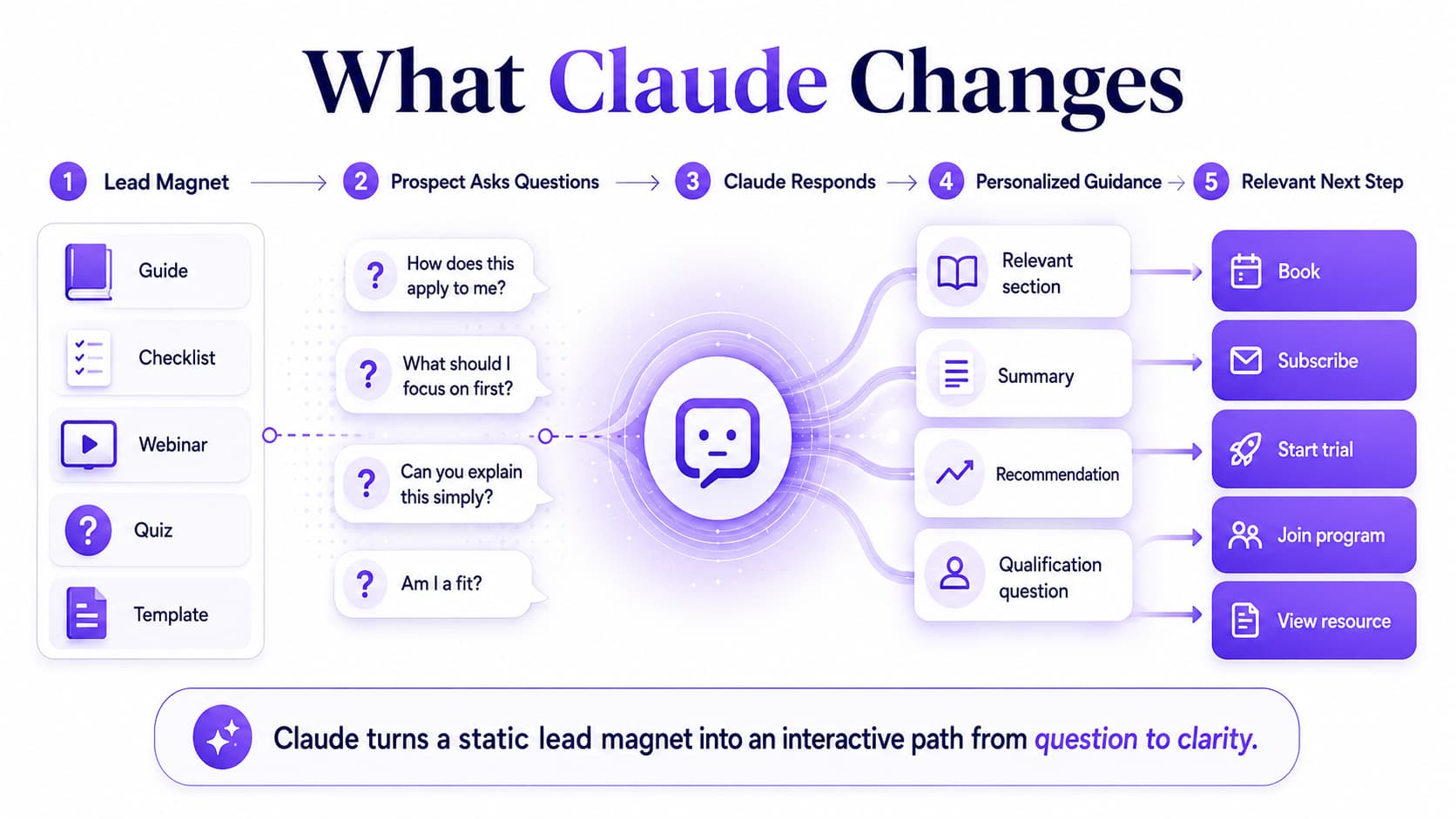
Claude, Anthropic’s AI assistant, changes that. When you add Claude to a lead magnet, the asset becomes interactive. Prospects can ask follow-up questions, get personalized guidance, understand the content more deeply, clarify fit, and move toward a more relevant next step while their attention is still active.
But Claude alone is not the full funnel.
Claude can power the intelligence. The real business value comes when that intelligence is connected to a branded experience that can capture leads, qualify intent, personalize the conversation, and guide prospects toward the right next step.
Why Static Lead Magnets Lose Qualified Leads
Lead magnets are not dead. Guides, checklists, webinars, quizzes, templates, and free trials are still common formats because they give people a reason to engage. Salesforce lists ebooks, checklists, free trials, webinars, quizzes, and templates among common lead magnet examples.
The problem is what happens after the opt-in.
A traditional lead magnet usually follows the same path: a visitor opts in, receives the asset, consumes part of it, and then gets dropped into a nurture sequence. The business hopes the email follow-up will do the work later.
That is a weak handoff when the prospect is interested now.
A consultant reading your guide may want to know whether the advice applies to their specific business model. A SaaS founder watching your webinar may want to know whether your product fits their stage. A course buyer completing your quiz may need help choosing the right program. A YouTube subscriber browsing your resource library may not know which video, offer, or next step is most relevant.
Static content cannot respond to any of that. It cannot ask a clarifying question, personalize the recommendation, qualify intent, or guide someone toward the next action.
So the prospect is left to connect the dots alone. Many will not.
That matters most for businesses that sell through education: consultants, agencies, coaches, course creators, creators, membership operators, and SaaS teams. These buyers often need trust before action. They do not usually convert because they saw one CTA. They convert when they understand the problem, trust the method, see relevance to their situation, and feel clear on what to do next.
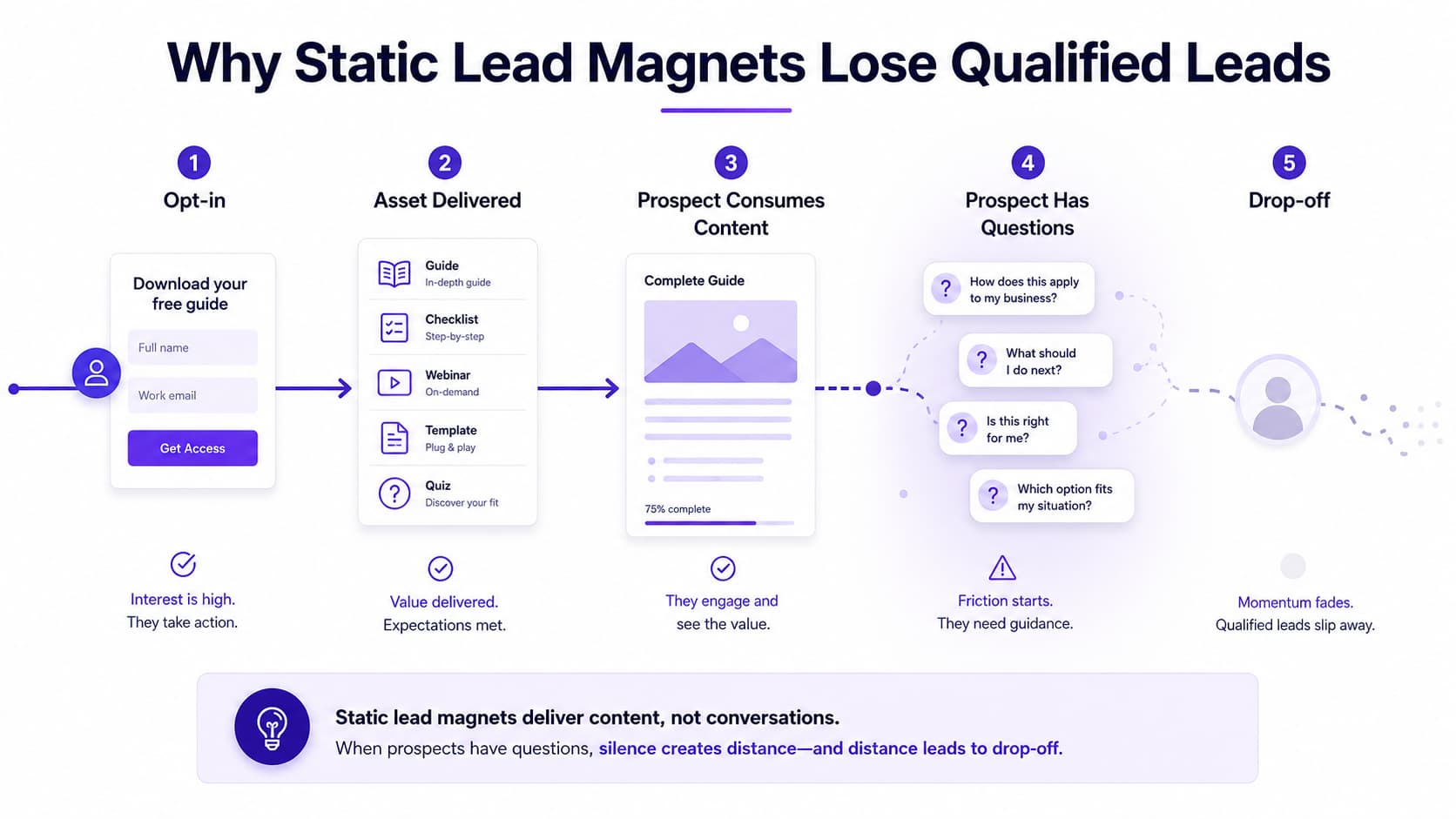
A static lead magnet may capture attention. A conversational lead magnet can turn that attention into a more useful conversion path.
What Claude Changes
Claude makes the lead magnet conversational, interactive, and personalized.
Instead of making prospects consume content alone, you give them a way to ask questions, go deeper, and get guidance based on what they share. A guide can answer questions. A checklist can help someone prioritize. A webinar can explain the key takeaways. A quiz result can become a personalized recommendation instead of a generic label.
This matters because lead magnet engagement is usually strongest right after someone takes action. They clicked, downloaded, watched, registered, or answered questions. Their attention is active. Their problem is top of mind.
That is the moment to guide them deeper.
Claude can help prospects ask questions like:
“How does this apply to my type of business?”
“Which section should I focus on first?”
“Can you explain this in simpler terms?”
“What would you recommend based on my situation?”
“Am I a fit for the next step?”
“Should I book a call or start with a resource?”
That kind of interaction makes the lead magnet more useful for the prospect and more informative for the business. The prospect gets clarity. The business learns what they care about, what they are trying to solve, and whether they may be a qualified lead.
For more complex lead magnet experiences, the Claude model you choose can matter. Claude Sonnet 5 may be useful when the experience needs deeper reasoning, multi-step qualification, or action-taking, such as consultative assessments, product-fit guidance, booking flows, or high-ticket offer recommendations. Claude Haiku 4.5 may be a better fit for faster, lighter experiences such as Q&A, summaries, checklist help, and simple resource recommendations.
But the model comparison is not the strategy. The strategy is making your lead magnet conversational enough to reduce drop-off and help qualified prospects move forward.
How Claude Can Improve Different Lead Magnet Formats
| Lead magnet type | What Claude can improve | What the funnel still needs |
|---|---|---|
| Guide or ebook | Answer follow-up questions and explain sections | Lead capture, offer path, next step |
| Checklist or template | Help visitors prioritize and apply the steps | Suggested prompts and action logic |
| Webinar or video training | Summarize, clarify, and continue the lesson | Booking, signup, or nurture path |
| Quiz or assessment | Explain results and recommend next steps | Qualification and routing |
| Course sample | Help prospects understand fit and next lesson | Program recommendation or enrollment path |
| Resource library | Recommend the right resource | Clear categories and conversion goal |
| Link-in-bio or website lead magnet | Guide visitors from curiosity to action | Branded experience and CTA placement |
A guide or ebook becomes more useful when the reader can ask how it applies to their situation. Instead of hoping someone reads the whole PDF and finds the right insight, Claude can point them to the relevant section, explain the idea, and recommend what to do next.
A quiz or assessment becomes more valuable when the result turns into guidance. Instead of telling someone they are “Type B” and ending the experience, Claude can explain what the result means, what issue they should prioritize, and which next step fits their situation.
A webinar or video lead magnet can keep working after the replay ends. Viewers can ask for the key takeaways, request a summary, clarify a framework, or ask how the lesson applies to their business. This is especially useful for YouTube creators and educators with strong video libraries, because Claude can help viewers find the most relevant video, lesson, resource, or offer instead of making them search manually.
A link-in-bio or website lead magnet may not need to be a download at all. The lead magnet can be the conversation itself: “Enter your website and get personalized guidance,” “Ask our AI which strategy fits your business,” or “Find the best resource for your goal.” For prospects who want relevance now, that can be more compelling than another static PDF.
Where a Basic Claude Setup Falls Short
A basic Claude setup can answer questions. That is useful, but it is not enough.
If the experience is disconnected from your brand, offer, capture flow, qualification criteria, proof assets, and conversion path, it may become another interesting interaction that leads nowhere.
The prospect asks a good question. Claude gives a helpful answer. Then what?
If the next step is unclear, you still lose momentum. If the AI does not know when to capture contact details, you miss the lead. If it cannot qualify intent, your team still has to sort prospects manually. If it cannot surface the right proof, calendar, form, or offer, the visitor still has to hunt for the next action.
That is the difference between an AI answer box and a conversational funnel.
An answer box responds. A conversational funnel guides.
A Claude-powered lead magnet should not only answer. It should know when to educate, when to ask a question, when to collect information, when to show proof, when to recommend a resource, and when to guide a qualified lead toward booking, signup, purchase, application, or another appropriate next step.
Claude can power the intelligence. The funnel experience determines whether that intelligence turns into movement.
How Surfn Turns Claude Into a Branded Lead Magnet Experience
Surfn lets businesses use Claude inside a branded AI Page or embedded AI agent trained on their content and shaped around a funnel goal.
While this article focuses on Claude, Surfn also lets you build agents powered by leading AI models, including Claude, Gemini, and OpenAI models like GPT. That gives you flexibility to choose the model that best fits the experience, whether you are building a lightweight Q&A flow, a personalized lead magnet, or a more complex qualification and action-taking journey.
That means the lead magnet does not have to live as a disconnected PDF, replay, quiz, or resource library. It can become a conversational experience that reflects your brand, understands your content, and guides prospects toward the right next step.
Use an AI Page as the Lead Magnet — or Embed It Where Interest Already Exists
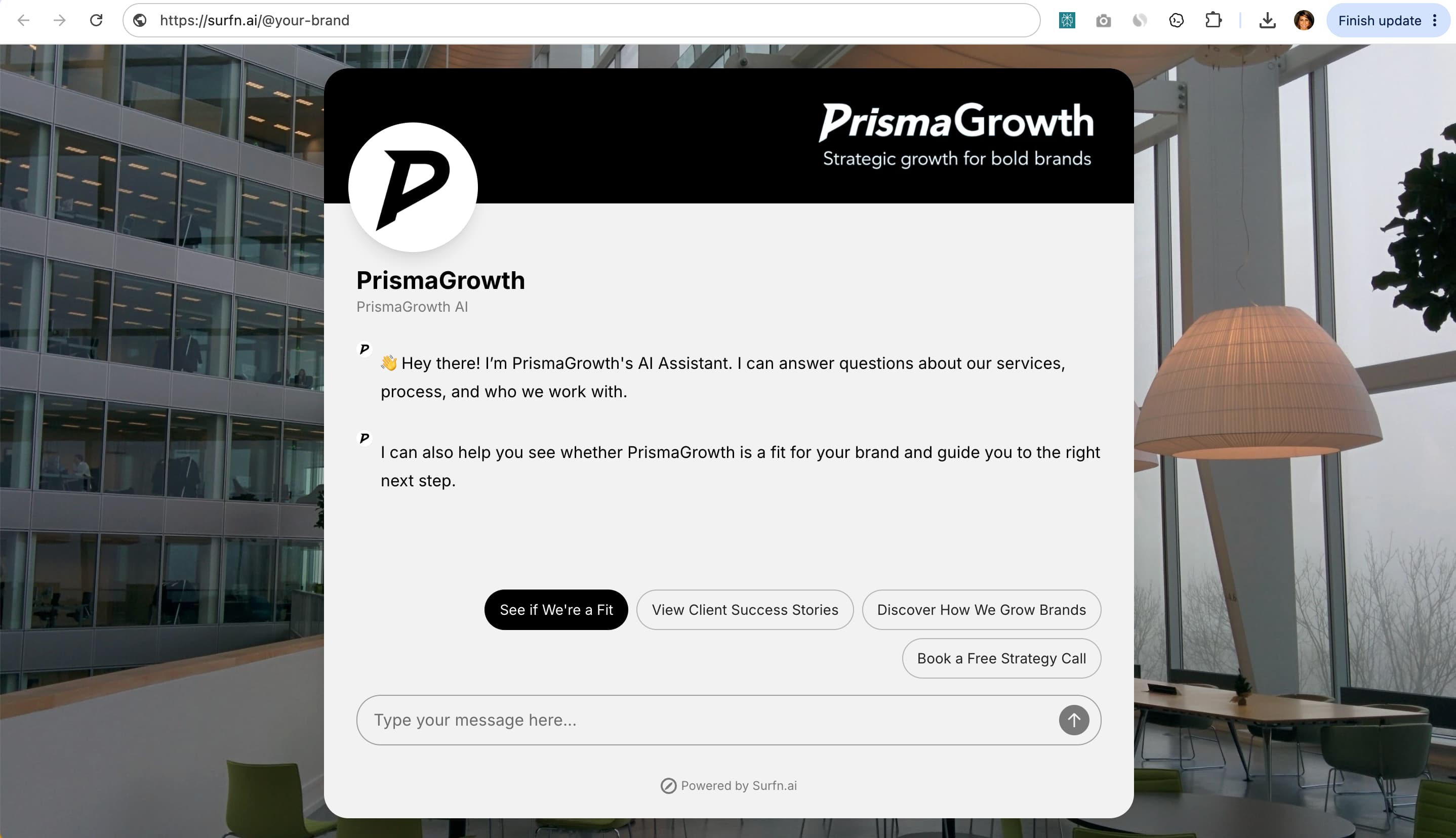
Example of a branded Surfn AI Page that can turn a static lead magnet into an interactive experience where prospects ask questions, explore relevant proof, qualify fit, and move toward the right next step.
A Surfn AI Page can be the lead magnet itself. Instead of asking visitors to download another static asset, you can invite them into a branded AI experience: “Enter your website and get personalized recommendations,” “Ask this guide how it applies to your business,” or “Find the best resource for your goal.”
This is especially strong when the prospect needs personalized guidance before they are ready to book, buy, or subscribe.
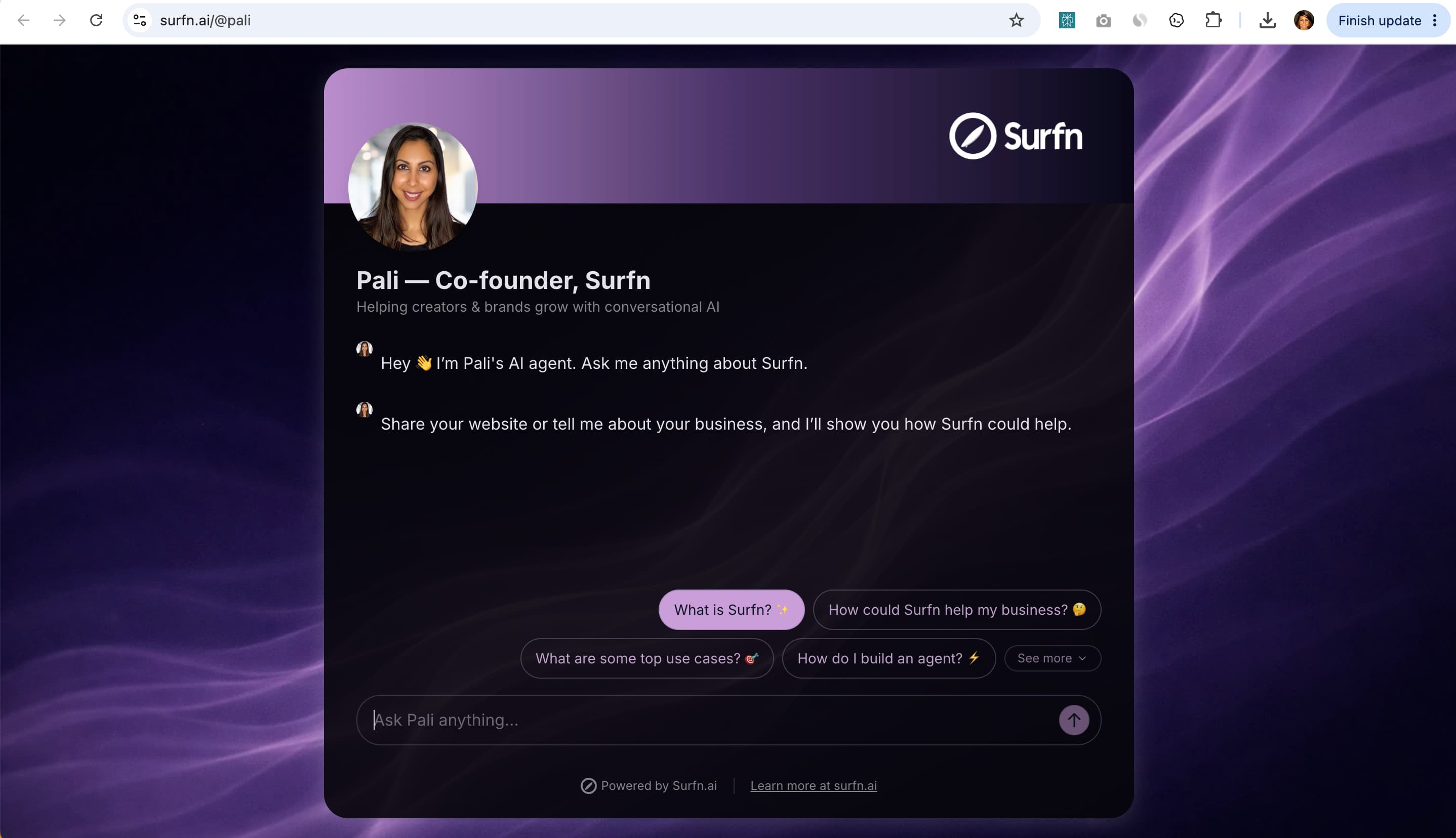
Example of my Surfn AI Page with Chat Personalization enabled, inviting visitors to share their website so the agent can tailor guidance to their business and recommend a relevant next step.
Surfn can also sit inside the lead magnet experience you already have. You can embed the agent into a lead magnet page, landing page, blog post, webinar replay, resource hub, pricing page, or website section where visitors commonly hesitate. The AI Page link can also sit behind CTAs, buttons, emails, newsletters, social posts, link-in-bio pages, ads, QR codes, or landing pages.
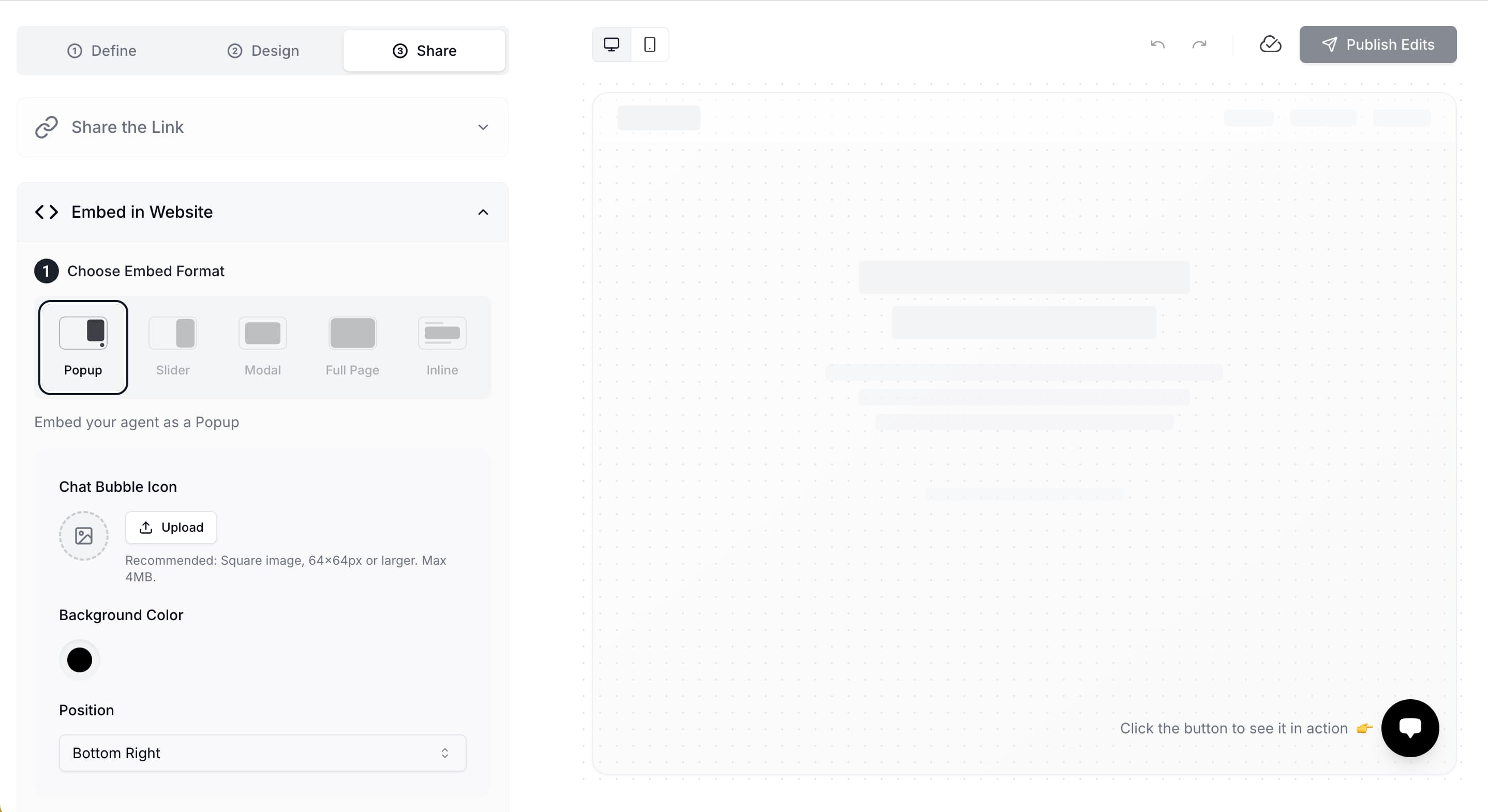
Surfn agents can be shared as a link or embedded directly on your website, with flexible formats like popup, slider, modal, full-page, or inline.
The point is placement. Put the conversation where interest already exists.
Train the Agent on the Content That Shapes the Decision
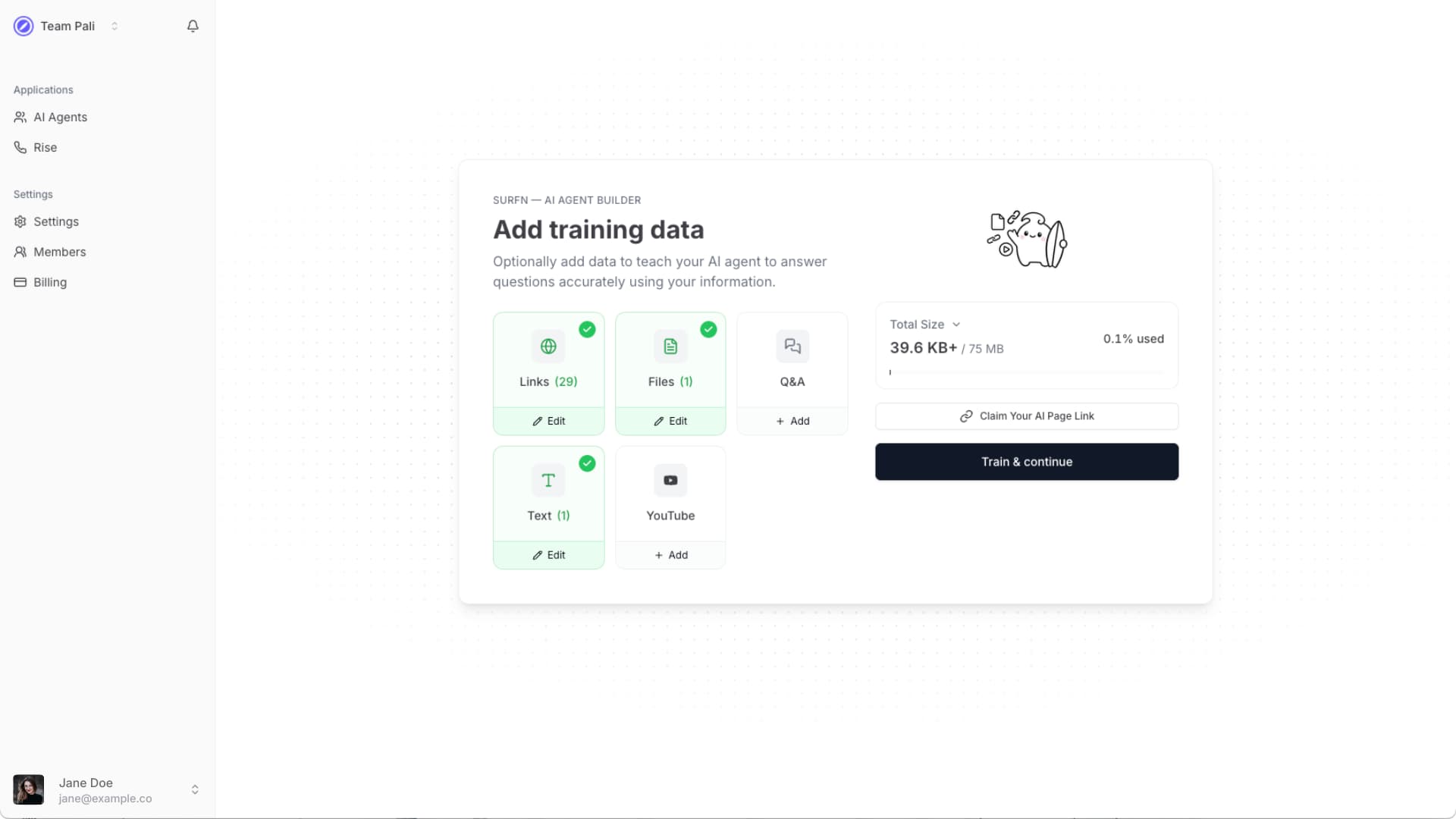
Surfn agents can be trained on your lead magnet content and related business materials, including links, files, Q&A, text, and YouTube videos, so the conversation stays grounded in what your audience needs to know.
Once someone engages, the Surfn agent can answer questions using the content it has been trained on: the lead magnet itself, your website, offer pages, FAQs, videos, YouTube transcripts, case studies, resources, and business context.
That gives prospects a way to understand the material, go deeper into the topic, and connect the content to their own situation without leaving the experience.
Capture, Qualify, and Route Prospects Inside the Conversation
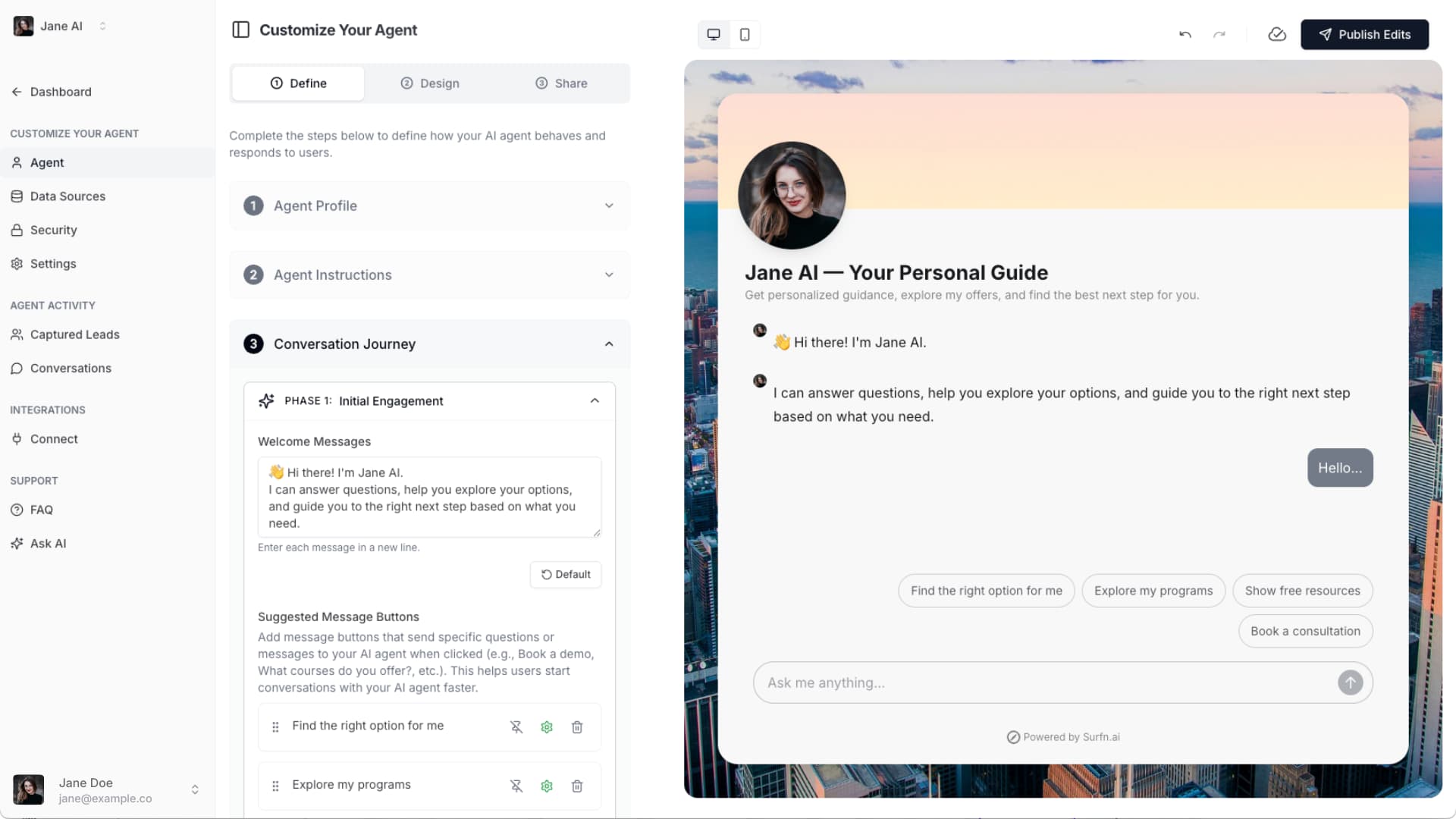
In Surfn, you can define how your AI agent behaves, customize its welcome messages, add suggested buttons that guide visitors into the right conversation, and assign tasks that help the agent capture, qualify, and guide prospects toward the next step.
From there, the experience can move beyond education into capture and qualification. Surfn can capture lead details conversationally, such as name, email, company, website, role, or goal. It can also use a configurable lead capture form that appears when the agent loads or after a set number of user messages, requiring contact details before the visitor continues.
For call-based funnels, the agent can ask qualification questions before showing the calendar. It might ask about business type, goals, timeline, budget, current challenge, or the kind of support the person wants.
Then conditional logic can route different prospects toward different outcomes: qualified leads toward booking, lower-intent visitors toward a resource or newsletter, and poor-fit visitors toward a lighter offer or more appropriate path.
That is where Surfn becomes more than a chat layer. AI Tasks can trigger actions inside the conversation, such as asking questions, capturing leads, displaying forms, embedding videos, showing booking widgets, surfacing resources, or guiding users to the right plan or next step.
Personalize the Experience and Keep the Conversation Moving
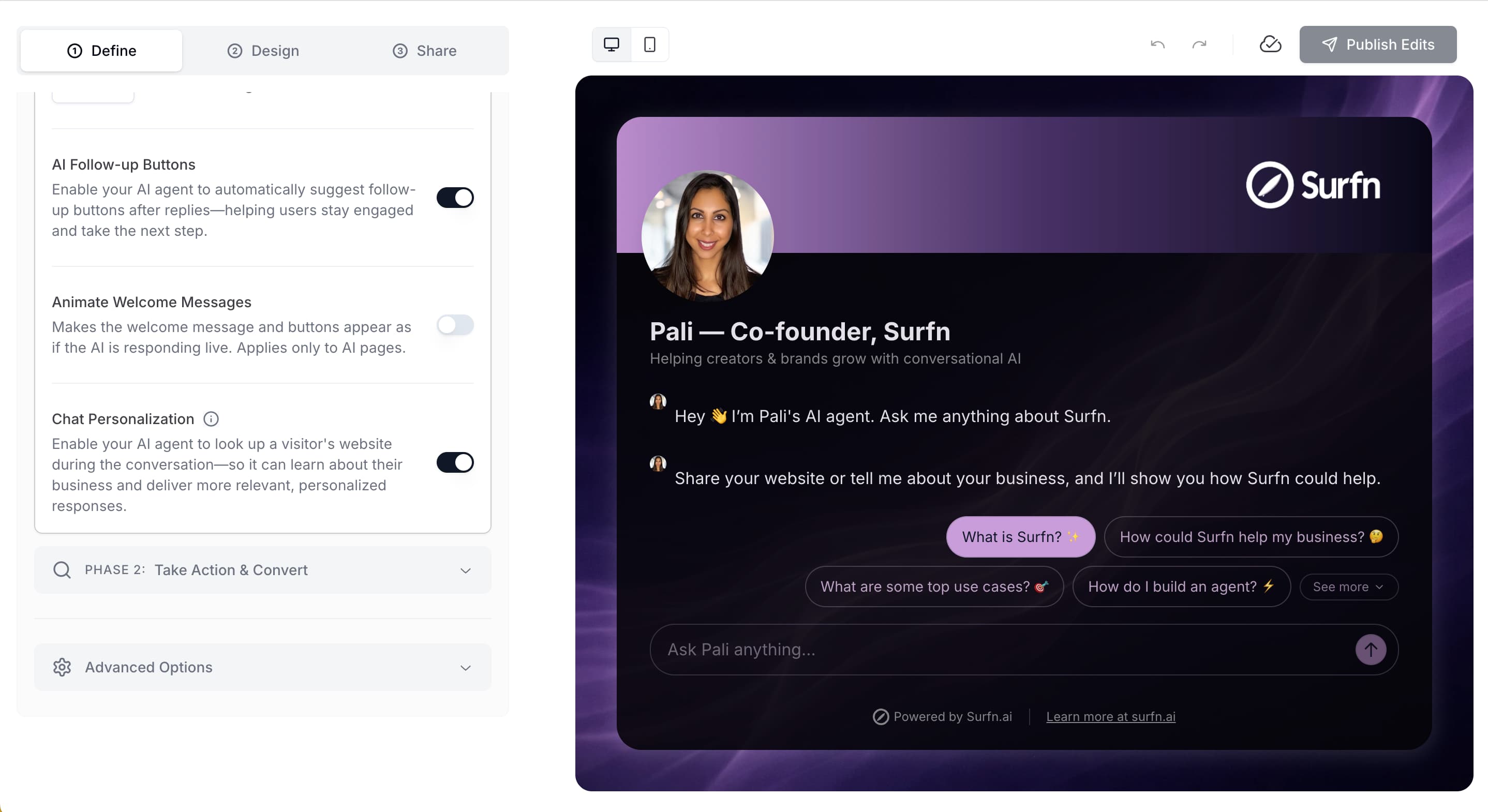
Surfn lets you enable AI Follow-Up Buttons and Chat Personalization so the agent can keep visitors engaged, ask for context like a website, and guide them toward more relevant next steps.
Chat Personalization adds another layer. With it enabled, the agent can ask for the visitor’s website, look it up during the conversation, and tailor guidance based on their business.
That creates a much stronger lead magnet concept than “download our guide.” For example: “Enter your website and get personalized guidance from an AI expert on improving your lead magnet funnel.”
AI Follow-Up Buttons help keep the conversation moving after each response. Instead of leaving visitors to decide what to ask next, the agent can suggest relevant next steps such as “Apply this to my business,” “Show me an example,” “Recommend the next resource,” or “Help me decide if I should book.”
This is the real product distinction.
Claude can make the lead magnet intelligent. Surfn turns that intelligence into a branded funnel experience that can capture, qualify, personalize, and guide.
A Simple Rollout Plan
Do not start by turning every asset into an AI experience. Start with one lead magnet where drop-off matters.
Choose a guide, webinar, checklist, quiz, course sample, resource library, or website page that already gets attention. Then define the main question the visitor is likely to have after engaging with it. Usually, it is something like: “How does this apply to me?”, “Which step should I take first?”, “Am I a fit?”, or “What should I do next?”
Train the agent on the lead magnet and the related business content it needs to answer accurately. That might include your offer page, FAQ, case studies, videos, pricing context, or relevant resources.
Then create three to five suggested prompts so the visitor does not land in an empty chat box. Decide when the agent should ask for contact information, what qualification questions matter, and what action should happen when someone is ready.
A simple first version might look like this:
| Business type | Conversational lead magnet idea |
|---|---|
| Consultant | “Ask this guide how it applies to your business.” |
| Agency | “Share your website and get personalized funnel recommendations.” |
| SaaS company | “Ask questions before booking a demo.” |
| Course creator | “Find the right lesson or program for your goal.” |
| YouTube creator | “Find the best video or resource to watch next.” |
| Membership operator | “See whether this community is right for you.” |
The goal is not to build a complicated AI funnel on day one. The goal is to create one focused conversational path that helps a qualified prospect move from interest to clarity.
Once people use it, review the conversations. Look for repeated questions, hesitation points, missing content, and moments where visitors seem ready for a next step. Those insights can improve the lead magnet, the agent, and the rest of the funnel.
Conclusion
Adding Claude to your lead magnet is not about making a PDF more futuristic.
It is about fixing the moment where qualified prospects usually drop off.
A static lead magnet can capture attention, but it often leaves the prospect alone with the most important questions. Claude can help them ask, learn, clarify, and get personalized guidance. But the strongest version is not Claude sitting beside a static asset. It is Claude inside a branded funnel experience that can capture, qualify, personalize, educate, and guide.
The goal is not just to make the lead magnet smarter. The goal is to stop losing qualified prospects after they consume the content and give them a clearer path from interest to action.
Turn Your Lead Magnet Into a Claude-Powered AI Experience
With Surfn, you can create a branded AI Page or embedded AI agent that helps prospects ask questions, get personalized guidance, share relevant details, answer qualification questions, and move toward the right next step.
Sign up free and start building your AI Page on Surfn.
Create your AI Page with Surfn →
FAQ
Can Claude turn a PDF lead magnet into an interactive experience?
Yes. Claude can help readers ask questions about a PDF, summarize sections, explain ideas, and understand how the content applies to their situation. The stronger setup is to connect Claude to a branded conversational experience that can also capture leads, qualify fit, and guide the next step.
What types of lead magnets work best with conversational AI?
Conversational AI works best when the lead magnet creates follow-up questions. Strong examples include guides, webinars, checklists, templates, quizzes, assessments, course samples, YouTube video libraries, resource hubs, and website-based lead magnets.
Do I still need an email opt-in if my lead magnet is conversational?
Usually, yes. But the opt-in does not always need to happen before value is delivered. You can capture contact information through a form or ask for it conversationally when the visitor wants a recommendation, resource, personalized summary, or next step.
How is a Surfn AI Page different from a basic chatbot?
A basic chatbot usually answers questions. A Surfn AI Page is a branded conversational experience designed for a funnel goal. It can answer questions, educate visitors, collect information, qualify prospects, personalize guidance, surface relevant content, and guide people toward an action.
Can I use Surfn to create a Claude-powered lead magnet?
Yes. Surfn lets you create a branded AI Page or embedded AI agent powered by Claude models, including Claude Sonnet 5 and Claude Haiku 4.5. You can train your agent on your lead magnet content, customize the experience to match your brand, capture and qualify leads, and guide visitors toward the right next step.
You can sign up free and start building at Surfn.