The Lead Qualification Guide: When to Automate Lead Qualification and When Not To
Most businesses qualify leads too late — after a prospect has already booked time on the calendar.
By the time qualification happens on a discovery call, time is already committed. The meeting is already on the books. And if the lead turns out to be a poor fit, that time is gone.
Others try to qualify leads upfront with a form — and to be fair, that can work well. Forms can help filter for budget, timeline, business type, goals, or other criteria before a meeting is ever booked. In many cases, that is far better than leaving your calendar completely open.
But forms have a limitation: many prospects are not ready to fill one out the moment they land on your page or click your CTA.
Often, they have a few quick questions first.
They may want to know whether you work with businesses like theirs, whether their budget is even in range, whether your service fits their situation, or whether it makes sense to book a call at all. If those questions are not answered quickly, the form can feel like too much effort too soon.
So while forms can screen for fit, they do not always move the buyer forward.
Then there’s the manual route. Many founders and consultants qualify leads themselves over email or DMs. Early on, this can work well. It helps you learn your market, hear objections directly, and build relationships. But over time, it becomes slow, inconsistent, and difficult to scale.
This matters in outbound too. Often, the smartest first layer of qualification happens before you ever send the cold email or DM. The more you filter for fit upfront, the less time you waste later. AI can help speed up prospect research and pre-qualification here — but a second layer of qualification is still usually needed once someone responds.
The issue is not that these approaches never work. It’s that they often happen too late, create too much friction, or rely too heavily on manual effort.
Good lead qualification is not just about filtering bad leads out.
It’s about helping the right leads move forward faster.
In many cases, the best qualification experience is one that allows a prospect to get a few upfront answers first, continue naturally into qualification, and only then be guided to the next step if there’s a fit. That creates a smoother path for the buyer and a more efficient one for the business.
Lead qualification works best when it happens as early as possible, with as little friction as possible, without removing the human touch where it actually matters.
What lead qualification is actually supposed to do
A lot of people think lead qualification is mainly about filtering people out.
That’s only part of it.
Good qualification is not just a gate. It protects your time, improves the buyer experience, and makes your sales process more efficient.
1. Protect your time
One of the biggest reasons lead qualification matters is simple: your time is limited.
Rupali Renjen is the co-founder of Surfn AI, where she builds conversational AI agents that help businesses and creators engage audiences, uncover deeper audience insights, and turn more conversations into growth.
Every bad-fit discovery call takes time away from the people who are actually a strong fit. Every live conversation spent answering basic screening questions eats into time that could be spent closing deals, serving clients, or doing higher-value work.
For consultants, agencies, and service businesses especially, this matters even more. If your team is spending billable hours on calls that should never have been booked in the first place, qualification is not just a sales issue. It becomes a profitability issue.
Good qualification helps reduce bad-fit calls, avoid unnecessary screening conversations, and keep your calendar focused on serious opportunities.
2. Improve the buyer experience
Qualification should not feel like friction for the buyer.
If the only options are “fill out this form” or “book a meeting,” many prospects won’t take either step yet. That does not mean they are unqualified. It often just means they need a little more clarity first.
Buying takes time too. Filling out a form or booking a meeting asks the prospect to invest effort before they fully know whether the next step will serve them well. While some buyers will do that, many won’t — especially if they still have a few initial questions and do not want to hunt across your website, LinkedIn page, case studies, or FAQ to find the answers.
A low-pressure conversational path can reduce that burden by helping them get clarity first, then continue naturally into qualification and booking if it makes sense.
Good qualification helps buyers move forward with confidence. It should make the process feel easier, not heavier. The best qualification flows reduce uncertainty, answer key questions, and create a path that feels simple and low-pressure.
3. Increase sales efficiency
Lead qualification should also make your sales process run better.
When qualification happens well, your team has fewer repetitive conversations. Prospects reach the meeting stage faster. And when a call does happen, it starts further ahead because the basics have already been covered.
That means less time spent re-explaining your offer, re-screening for fit, or sitting through calls that never had real potential to begin with.
Instead of using live conversations for basic filtering, you can use them for what they are best at: strategic discussion, trust-building, and closing.
At its best, lead qualification is not just about screening people out.
It’s about protecting time, reducing friction, and helping the right opportunities move forward faster.
The four main ways businesses qualify leads
There is no single best way to qualify a lead.
The right approach depends on your sales process, the complexity of your offer, the volume of leads you’re dealing with, and how much trust or education is required before someone is ready to move forward.
In practice, most businesses qualify leads in one of four ways.
1. Manual qualification over DMs or email
This is especially common in founder-led sales, consulting, and service businesses where the sales process is relationship-driven and the volume is still manageable.
Manual qualification works well when you are still learning your market, refining your offer, or trying to understand which types of leads are actually worth pursuing. It gives you direct exposure to objections, buying signals, language patterns, and the kinds of questions prospects ask before they commit.
That kind of exposure is valuable early on. If you automate too soon, you may end up optimizing the wrong process before you fully understand what good-fit demand actually looks like.
Manual qualification can also make sense when trust matters early. Some services are nuanced, high-ticket, or highly relationship-driven. In those cases, a live human interaction can build confidence faster than a systemized flow. If chemistry, context, or strategic nuance play a major role in the sale, keeping the process more personal upfront may be the better route.
It can also work well when lead volume is low and each opportunity is high value. If you are only speaking to a small number of serious prospects, manual qualification may be perfectly reasonable. Not every business needs the same level of automation or systemization.
But it also comes with tradeoffs.
Manual qualification is hard to standardize. It depends heavily on who is replying, how quickly they respond, and how consistently they ask the right questions. As lead volume grows, it becomes slower, less efficient, and much harder to scale.
What works well at a low volume often becomes a bottleneck later.
This matters in outbound too. Often, the smartest first layer of qualification happens before you ever send the cold email or DM. The more you filter for fit upfront, the less time you waste later. AI can help speed up prospect research and pre-qualification here — but a second layer of qualification is still usually needed once someone responds.
2. Form-based qualification
Forms are one of the most common ways businesses qualify leads upfront.
They are useful for collecting structured information such as company details, role, budget, timeline, and project scope before a meeting is ever booked. When a buyer already understands your offer and is ready to take the next step, forms can be a simple and effective way to screen for fit.
That makes them far better than leaving your calendar open to anyone.
But forms work best when the prospect is already ready.
If someone still has basic questions about fit, pricing, process, timeline, or whether your service even applies to their situation, a form can feel premature. It asks the buyer to do work before they feel confident enough to move forward.
That is where forms start to underperform.
Forms collect information well.
They handle hesitation poorly.
They do not answer questions. They do not build trust in real time. They do not help a buyer think through whether the next step makes sense. Instead, they ask for effort before delivering clarity.
And when a prospect is still uncertain, that can make the form feel more like homework than progress.
This also creates a flow problem.
A visitor reads your page, clicks your CTA, sees a form, and leaves. Not always because they are a bad lead, but because they are not ready to fill it out yet. Every extra step creates drop-off, especially when the buyer still has unresolved questions.
That is the tradeoff.
Forms can be effective when the buyer is already informed, motivated, and ready. But when confidence is low and questions are still getting in the way, forms often collect data without doing much to move the conversation forward.
They screen, but they do not educate.
They capture information, but they do not build momentum.
3. Qualification during the consultation call
This is still one of the most common ways businesses qualify leads, especially in service businesses.
A prospect books a discovery call, and the qualification happens live during the meeting. Sometimes this is intentional. Other times it happens simply because there is no real qualification layer before the call.
For many businesses, this becomes the default without anyone realizing how expensive it is.
This approach can be useful in the early stages of a business. If you are still testing your offer, learning your market, or trying to understand where demand is coming from, live calls can give you valuable insight. Founder-led discovery calls are often one of the fastest ways to hear objections, understand buying intent, and figure out what good-fit demand actually looks like.
But once patterns become clear, qualifying on the call usually becomes too expensive to keep as the default.
Time is your scarcest sales resource. Using a live call for basic screening is a poor trade, especially when the same questions keep coming up again and again. If something could have been answered before the meeting, it probably should have been.
And in many cases, that is exactly what is happening.
A lot of prospects book calls not because they are fully ready to buy, but because they still lack clarity. They want to know whether you work with businesses like theirs, whether their budget is even in range, what your process looks like, how soon you can start, or whether your service fits the scope of what they need.
Those are important questions. But they do not always require a live meeting just to get answered.
That is where the model breaks down.
If the same screening is happening on every call, the process is too late and too manual. It creates avoidable calendar clutter, wastes billable hours, and pulls attention away from stronger opportunities. Using a consultation call to do work that could have happened before the meeting is one of the most expensive bottlenecks in a service business.
Calls should usually be reserved for conversations that actually require human judgment, deeper context, trust-building, or strategic discussion.
4. Conversational AI-assisted qualification
Conversational AI-assisted qualification creates a middle layer between static forms and live sales conversations.
Instead of forcing a prospect to either fill out a form or book a call right away, it gives them a way to ask questions, get answers instantly, and continue into qualification within the same flow. That creates a lower-friction path to conversion, especially for buyers who want clarity before committing.
This is where conversational AI can be a better option than a form.
A form asks the prospect to stop and complete a rigid set of fields before they have fully decided whether the next step makes sense. Conversational AI can handle that moment differently. It allows the prospect to get quick answers first, then continue naturally into qualification once they feel more confident.
Done well, this approach can educate and qualify at the same time.
That continuity matters.
A lot of AI tools can answer questions, but then send the prospect somewhere else — to a form, a calendar page, or another external step — once they show interest. That creates a new point of friction, and every extra handoff increases the chance the lead drops before converting.
A stronger qualification experience keeps everything in one place. The prospect can ask questions, get clarity, be qualified naturally, and move to the right next step inside the same conversation. When that all happens in one flow, the experience feels smoother for the buyer and is more likely to convert than sending them elsewhere midway through.
It also does not have to feel rigid.
A prospect can ask whether you work with businesses like theirs, what your process looks like, whether their budget is likely in range, whether your service fits their scope, or whether a call even makes sense. While that conversation is happening, the system can also gather structured qualification information without forcing the buyer through a static intake form upfront.
And if the AI is in the middle of asking qualification questions and the prospect wants to ask a quick question first, they can. The AI can answer naturally, then continue the flow without forcing the person to start over or leave the conversation.
That flexibility matters. A form feels fixed. A conversation feels responsive. Being asked one question at a time often feels easier than being shown a long intake form all at once.
It also creates better routing.
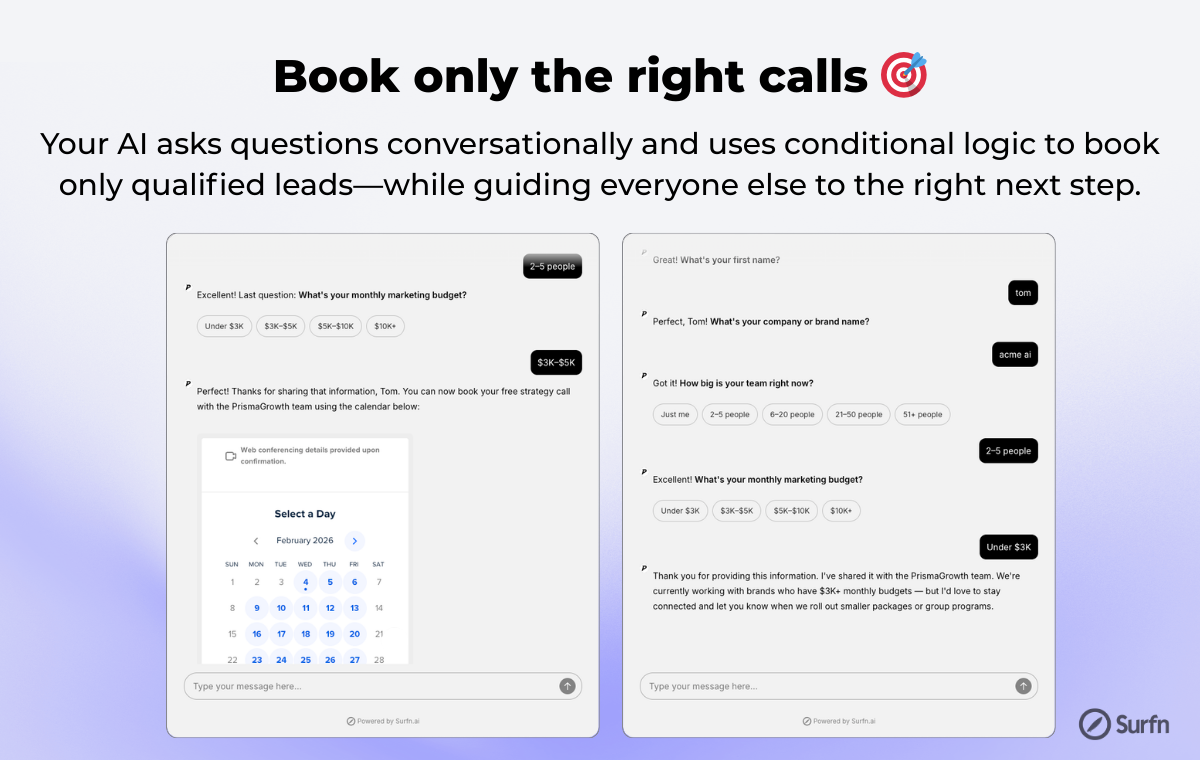
Qualified leads can be guided toward booking a consultation. Leads who are not ready yet can be directed to resources, content, or a newsletter. Poor-fit leads can be politely redirected to a lighter offer or another next step instead of taking up time on your calendar.
Importantly, the right AI qualification agent does not try to replace your sales team. A well-configured conversational AI agent is grounded in your actual website, case studies, service positioning, and defined boundaries. It can answer common questions and guide the buyer through early qualification. But when a prospect asks something that requires custom strategy — such as what your approach would look like for their specific business — the agent should recognize that moment and guide them toward a consultation where your team can provide tailored insight.
The key is that this only works well when the AI is grounded in your real offer, actual content, and clear boundaries. It should support the sales process, not pretend to be your sales team.
How to choose the right qualification method
The right qualification method depends on where your business is today, how your sales process works, and what your buyers need before they are ready to move forward.
Use manual qualification when
Manual qualification makes the most sense when you are early stage, still learning the market, or trying to understand what good-fit demand actually looks like. It also works well when the sale is high-trust and low-volume, and when relationship-building is part of the qualification itself.
Use forms when
Forms work best when you need straightforward intake, the buyer already understands the offer, and the goal is to collect structured information quickly. If the prospect is already motivated and does not need much clarification, a form can be an efficient next step.
Use conversational AI when
Conversational AI is often the best option when prospects need clarity before booking, and you want to qualify and educate in one flow. It is especially useful when you want to reduce friction without losing control, protect your team’s time, and still offer a helpful, low-pressure experience.
Use live-call qualification when
Live-call qualification makes sense when the sale is highly custom, you are still refining the offer, or the conversation itself is part of the value. In those cases, the call is not just for screening — it is part of the discovery, trust-building, or strategic process itself.
Where a conversational qualification agent can live
A conversational qualification agent does not have to live only on your website.
It can live anywhere a prospect is likely to have questions, hesitate, or need a low-pressure next step.
That might be on your website, in a follow-up email, inside a cold outreach reply, in LinkedIn DMs, in your link in bio, inside blog posts or newsletters, or behind a QR code at an event.
That matters because qualification no longer happens in one place.
Some prospects discover you through content. Others reply to outreach. Others land on your site, scan a handout, or click a link from social media. The more naturally you can meet them in those moments, the less likely intent is to fade before action happens.
For businesses without a fully built-out website, a conversational AI page or link-in-bio experience can even serve as the primary qualification layer on its own.
What to look for in a conversational qualification platform
Not all AI tools are built for qualification.
If you only need basic FAQ support, a simple chatbot may be enough. But if you want to guide buyers, qualify fit, and move them to the right next step, you need more than an AI that just answers questions.
A strong conversational qualification platform should do four things well.
It should answer questions based on your real business, content, and positioning.
It should ask qualifying questions conversationally, so buyers can move through the flow naturally instead of facing a rigid intake form.
It should support conditional logic and routing, so qualified leads can be invited to book while others are guided to a more appropriate next step.
And it should be flexible to share across the channels where your prospects already engage — not just as a website embed, but also as a link, branded page, or other shareable experience.
Just as importantly, it should be customizable enough to reflect your brand and voice instead of feeling like a generic chatbot bolted onto your funnel.
What a modern qualification flow looks like
A strong qualification flow starts before the meeting — and sometimes before outreach even begins.
In outbound, that means filtering for fit before you ever send the cold email or DM.
In inbound, it means giving buyers a low-pressure way to ask questions, get clarity, and understand whether there is a fit before asking them to commit to a form or a meeting.
A practical example might look like this:
A visitor lands on your site, asks whether you work with businesses their size, gets an instant answer, is asked two or three qualification questions, and only then sees a booking option if they are a fit.
If they want to ask something along the way, they can. The AI can answer naturally, then continue the qualification flow without forcing them to start over or leave the conversation.
That is what makes the experience work. The conversation, qualification, and next step all happen in one place. Instead of answering questions in one interface and sending the prospect somewhere else to continue, the flow stays connected — which reduces friction and lowers the chance of drop-off.
If the prospect is not ready yet, they can be guided to a more appropriate next step, such as a helpful resource, newsletter, or another lower-pressure path.
That is what a modern qualification flow should do: reduce friction for the buyer, protect time for your team, and create a clearer path between initial interest and the right next step.
Final takeaway
Not every business should automate lead qualification in the same way.
Manual qualification still has a place, especially when you are early, still learning, or selling in a high-trust, low-volume environment.
Forms are useful too. They work well for structured intake when the buyer already understands the offer and is ready to move forward.
Live calls still matter — but they should usually be reserved for conversations that truly require human judgment, nuance, and strategic discussion.
For many businesses, conversational AI is the strongest middle layer.
It combines clarity, convenience, qualification, and routing in one experience. It gives buyers a low-pressure way to explore, helps teams avoid repetitive screening, and creates a smoother path from intent to action.
Why we built Surfn
For many businesses, the real problem is not traffic.
It is the gap between intent and action.
A prospect is interested, but not ready to fill out a form. They have questions, but not enough to justify a live call. They want a low-pressure way to explore, understand fit, and move forward if it makes sense.
Surfn is designed to help businesses close that gap with branded conversational AI agents that do more than answer questions. Surfn agents can guide the conversation forward, ask qualifying questions naturally, and use conditional logic to decide what should happen next.
That matters because many AI tools stop at answers. They respond to questions, then send the prospect elsewhere to fill out a form or book a meeting. Surfn is designed to keep that momentum inside the same conversation — so prospects can ask, learn, qualify, and take the next step without unnecessary handoffs.
That means you can answer common questions, qualify leads upfront, show your calendar to everyone or only to qualified leads, and route lower-fit prospects to content, a newsletter, or another next step.
And because qualification does not happen in one place, Surfn can be shared across more than just a website embed. It can live behind a link, be embedded on your site, added to your link in bio, used in outreach, included in newsletters and blog posts, or shared through QR codes at events and in-person materials.
You can sign up for free, train an agent on your website or content in minutes, customize it to reflect your brand, and start testing a more conversational approach to qualification without needing a developer.
If your current process forces prospects to choose between a static form and a live meeting too early, it may be costing you qualified leads.
Surfn gives you a more flexible way to answer questions, qualify fit, and guide buyers to the right next step — without adding friction for them or wasted time for your team.
See It In Action
Want to see how Surfn could help your business answer questions, qualify leads, and book the right prospects?