
Most businesses still make prospects do too much work.
A visitor has a question. They search the website, open the FAQ, click a form, and decide whether filling it out is worth the effort. Or they leave.
The problem is not always traffic. It is what happens after someone becomes interested. Most businesses already have tools for this part of the funnel—forms, calendars, websites, email, DMs, and sometimes a chatbot. The problem is that these tools are often disconnected.
Every time a prospect has to leave one experience, find another page, repeat information, or figure out the next step alone, you create another place for them to drop off.
The Current Top-of-Funnel Has Three Big Gaps
Static forms collect information. They do not create clarity.
Forms are useful. They can collect contact details, company information, budget, timeline, project needs, and other qualification data. They can even route someone toward a booking calendar.
But a form cannot answer the question stopping someone from filling it out.
A prospect may only want to know:
- Do you work with businesses like mine?
- Is my budget realistic?
- Which service should I choose?
- How does your process work?
- Is it even worth booking a call?
If they do not know yet, asking them to complete six fields can feel like work before they know whether the work is worth doing.
Forms work well when the buyer is ready. They do very little to make the buyer ready.
Manual DMs and email work—but many prospects still won’t respond
Manual conversations can be extremely valuable. If your business is small, you are still learning the market, or you sell a highly customized service, speaking directly with prospects gives you information no automation can replace. It also works when trust and personal judgment are part of the sale.
But manual email and DMs have a limitation on both sides of the funnel. Sometimes the prospect has to contact you first. Many will not. Other times, you contact them through outbound. They see your email or DM. They may even be interested—but they are not interested enough yet to reply, book a call, or start a sales conversation. You follow up, and they still do not respond.
That does not always mean they are a bad prospect. They may still be wondering what you actually do, whether it applies to their business, what it costs, whether you have relevant experience, or whether replying will immediately turn into a sales pitch.
Many buyers would rather research those questions privately before engaging with a person. If they cannot get that clarity quickly from your website, content, or other digital touchpoints, the conversation may end before it ever starts.
And some of the prospects who go silent are exactly the ones you wanted to reach.
Basic AI chatbots answer questions. Then many stop.
AI Q&A is already an improvement. Train a chatbot on your website, services, FAQs, or other business information and a visitor can ask questions instead of searching through pages. That creates clarity.
But this is where many chatbot experiences stop too early.
Imagine a prospect asks:
“Do you work with SaaS companies like ours?”
The AI gives a great answer. Now they are more interested than they were 30 seconds ago. They want proof, pricing, a relevant case study, or they are ready to book.
But the chatbot does not show the case study. It does not ask the qualification questions. It does not present the video. It does not open the form. It does not put the calendar in front of them.
The visitor has to leave the conversation and start searching again.
You solved the information problem. Then you created another handoff before conversion.
The problem is not that forms, people, or Q&A chatbots are useless. The problem is that the buyer still has to connect them.
What a Better Top-of-Funnel Experience Looks Like
The right conversational AI agent connects the journey:
Answer → Capture → Qualify → Show Proof → Take Action
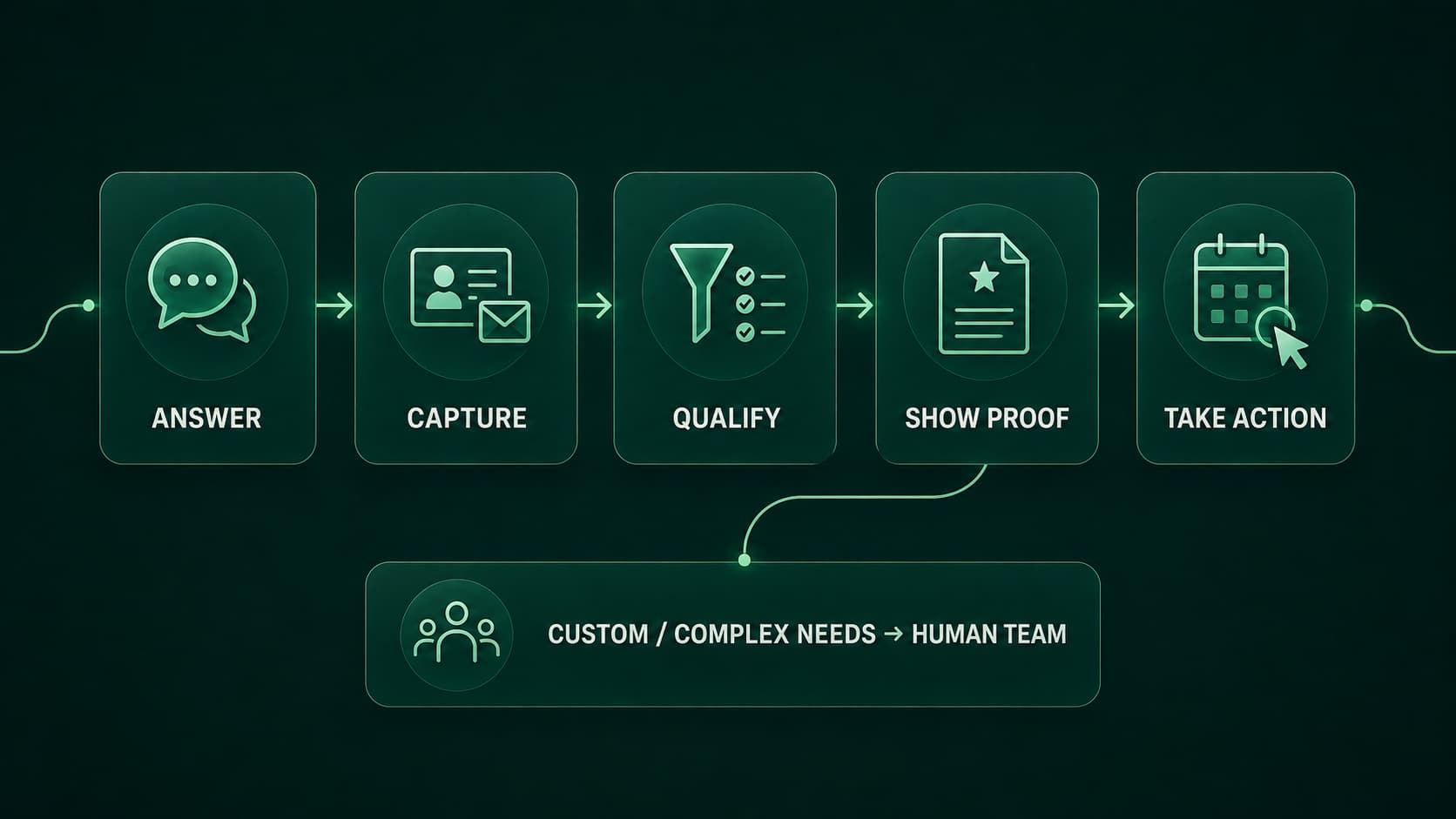
1. Answer
Give prospects fast, personalized answers to the questions standing between interest and action.
That might include:
- who you work with
- what you offer
- how the process works
- pricing guidance
- which option fits
- what happens next
The goal is not to dump more information on the prospect.
It is to answer what they need now.
2. Capture
Once you have provided some value and intent is clear, collect a reliable way to follow up.
Usually that means email. Phone can make sense when calls or texts are part of your process.
Do this before a long qualification flow.
A conversation can end at any point.
If the person answers three questions and disappears on question four, you still want the contact information they already shared.
3. Qualify
Ask only what you actually use to establish fit.
For a service business, that may include:
- company or business type
- goal
- problem
- project scope
- timeline
- budget
Ask one question at a time.
Qualification should make the process easier, not feel like a longer form disguised as AI.
4. Show proof
When someone needs more confidence, show them what matters.
A relevant case study.
A testimonial.
A demo.
A video.
Portfolio work.
An example.
A useful article.
Do not make them leave the conversation and hunt for it.
5. Take action
When the prospect is ready, surface the right next step.
That might be:
- book a call
- complete a form
- explore an offer
- sign up
- watch a demo
- join a newsletter
- read a resource
- contact the team
Not everyone should get the calendar. A good funnel guides people based on where they actually are.
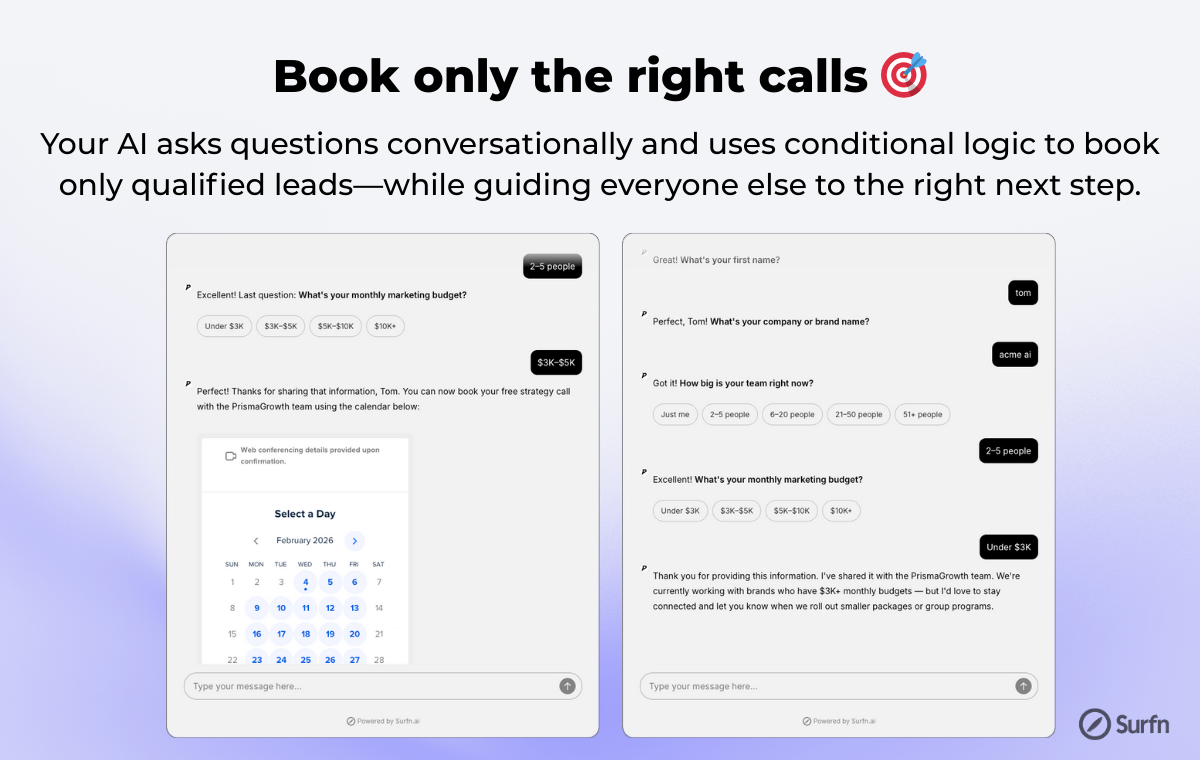
Imagine an agency prospect asks if you work with B2B SaaS companies. The AI answers. They ask for an example, so it shows a relevant SaaS case study. It captures their email, then asks about goals, timeline, and budget.
They are a strong fit, so the calendar appears in the conversation.
That is a very different experience from:
Read page → find form → submit form → find calendar → book.
AI Should Handle the Repeatable Part. People Should Handle Judgment.
The goal is not to replace your sales team.
It is to stop using your sales team for work software can handle before the conversation becomes valuable.
AI is useful for:
- initial pre-sale questions
- established pricing and process information
- contact capture
- early qualification
- showing relevant proof
- routing
- configured next actions
People are better for:
- custom recommendations
- solution design
- complex pricing
- unusual requirements
- strategic discussions
- negotiation
- closing
- anything that requires real judgment
If a prospect asks:
“Do you work with SaaS companies?”
AI can answer.
If they ask:
“What exact growth strategy would you recommend for our SaaS company?”
send them toward a person.
Gartner's 2026 buyer research captures this well: buyers increasingly want digital self-service, but they still turn to salespeople for validation and decision support at important moments.
AI should handle the repeatable first layer.
People should handle the parts where people are actually valuable.
Why We Built Surfn
That gap between getting an answer and actually moving forward is one of the reasons we built Surfn. We did not want to build another chatbot that stops at Q&A.
Surfn is designed to work more like a helpful sales rep, advisor, or guide inside your digital funnel. Your agent can answer questions using your content, ask questions, capture leads, qualify fit, show relevant proof, trigger different paths based on what someone says, and present the right action when the moment makes sense.
It can also live beyond a small chatbot icon in the corner of one website. You can share a Surfn agent as a branded AI Agent Page, embed it into your website, link to it from social or email, put it behind a CTA, or open it from a QR code.
Surfn is not meant to replace your website, form, calendar, or sales team. It connects them through a conversational layer.
How to Build Your Top-of-Funnel Agent With Surfn
You do not need to rebuild your entire funnel.
Start with one place where prospects already hesitate.
Step 1: Pick the job
Do not start with the AI.
Start with the conversion goal.
For example:
- capture more website inquiries
- qualify prospects before booking
- help visitors choose a service
- convert social traffic into leads
- turn lead-magnet readers into conversations
Then answer four questions:
- Who is this agent for?
- What makes someone a good lead?
- What should the ideal prospect do next?
- What should happen if they are interested but not ready?
Keep version one focused.
One agent. One audience. One primary job.
Step 2: Train it on what buyers need
In Surfn, you can train your agent using website pages, files, Q&A pairs, text, and YouTube transcripts.
Start with the information that affects the decision:
- services
- offers
- who you work with
- pricing guidance
- process
- FAQs
- case studies
- proof
- useful resources
Do not train it on everything simply because you can.
Train it on what helps the visitor decide.
Step 3: Define its role and boundaries
Now tell the agent how it should behave.
Set its role, brand, tone, instructions, and welcome message.
For a service business, you might tell it:
Answer initial questions about our services using the information provided. Help visitors understand whether we may be a fit. Do not give tailored strategy or custom recommendations. When someone needs custom guidance, direct them to speak with our team.
This matters.
Your agent should know both what it should do and where its role ends.
Step 4: Give people obvious ways to start
Do not make visitors stare at an empty chat box.
Add a few Suggested Message Buttons.
For an agency, these might be:
- Is this right for my business?
- How does your process work?
- What does pricing look like?
- Show me client results
- I want to talk
A visitor can understand what the agent is useful for before typing anything.
Step 5: Build the lead capture and qualification flow
This is where Surfn's AI Tasks come in.
AI Tasks use simple WHEN → DO logic.
For example:
WHEN
A visitor wants to work with you
OR
A visitor asks about a consultation
ASK
- What's your name?
- What's the best email to reach you?
- What company are you with?
- What are you trying to accomplish?
- What's your timeline?
- What's your approximate budget?
Surfn asks the questions conversationally, one at a time.
Put important contact information before the longer qualification questions.
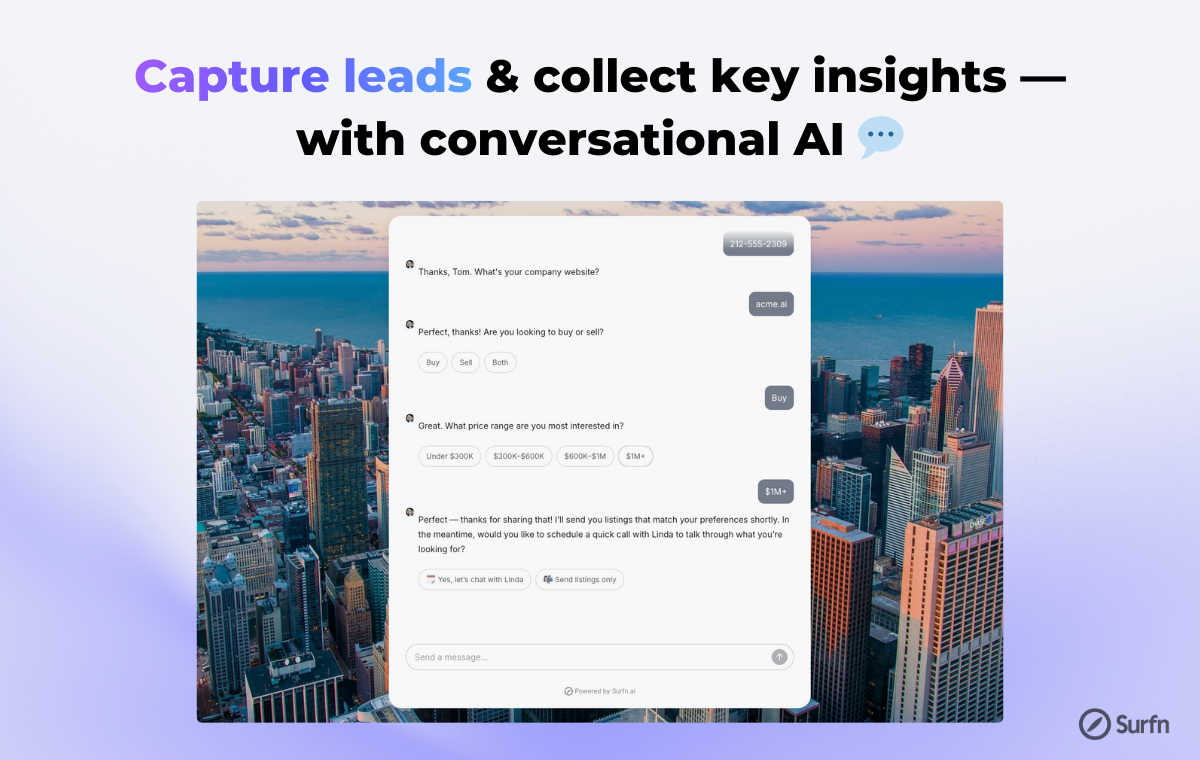
Surfn saves captured lead information and responses in real time as the visitor provides them. If someone leaves before finishing every question, you still keep what they already shared.
New Lead Email Alerts can also notify the workspace owner when a lead is captured, so your team can follow up.
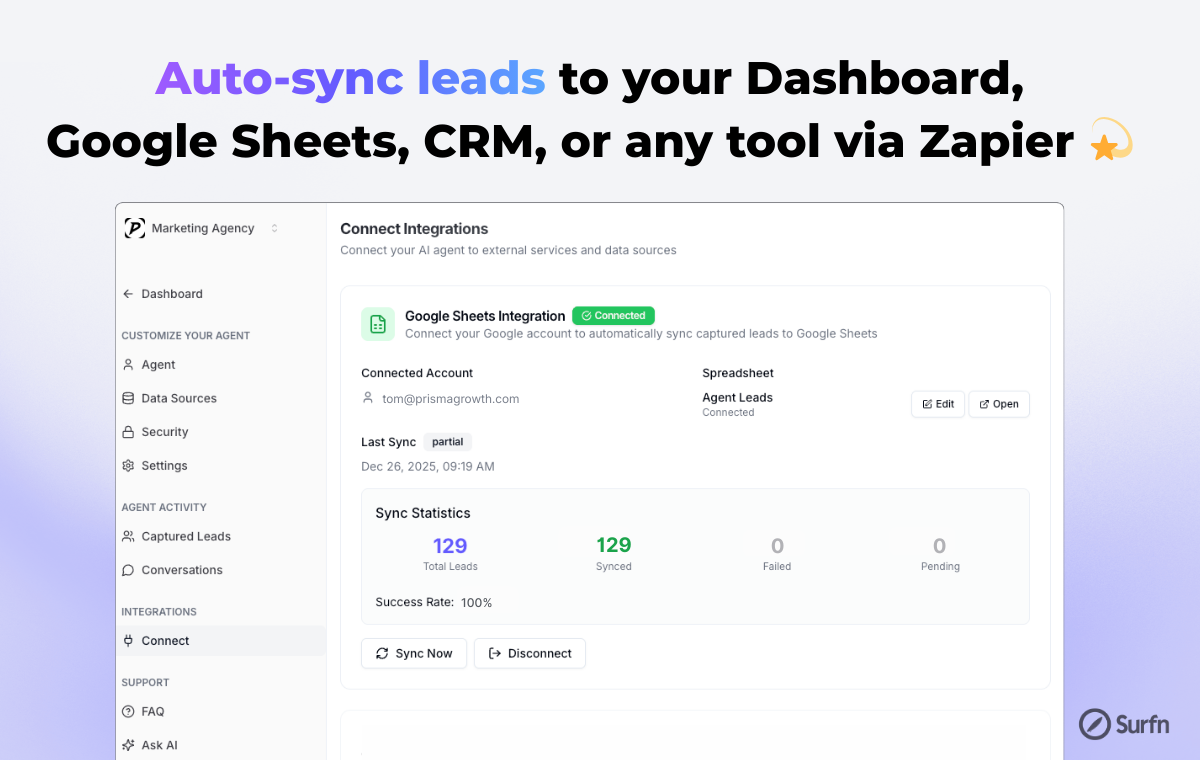
If you use Surfn's Google Sheets integration, captured leads can sync into a Sheet in real time and become the starting point for other workflows.
Step 6: Decide what happens next
Qualification is routing, not rejection.
For example:
IF
The need matches your service
AND the budget fits
AND the timeline makes sense
THEN
Show the booking calendar.
OTHERWISE
Show a relevant guide, alternate offer, form, newsletter, or another useful next step.
Someone who is not ready for your calendar today can still become valuable later.
Step 7: Bring proof and actions into the conversation
This is where Surfn moves beyond basic Q&A.
AI Tasks can surface configured actions and content such as:
- booking calendars
- forms
- videos
- image grids
- buttons
- rich text and links
- embedded content
Keep the logic simple.
Asked about results → show the case study.
Asked how it works → show the video.
Ready to talk → show the calendar.
Interested but not ready → show the guide.
Do not make the prospect leave the conversation to find the thing you already know they need.
Step 8: Make it feel like your brand
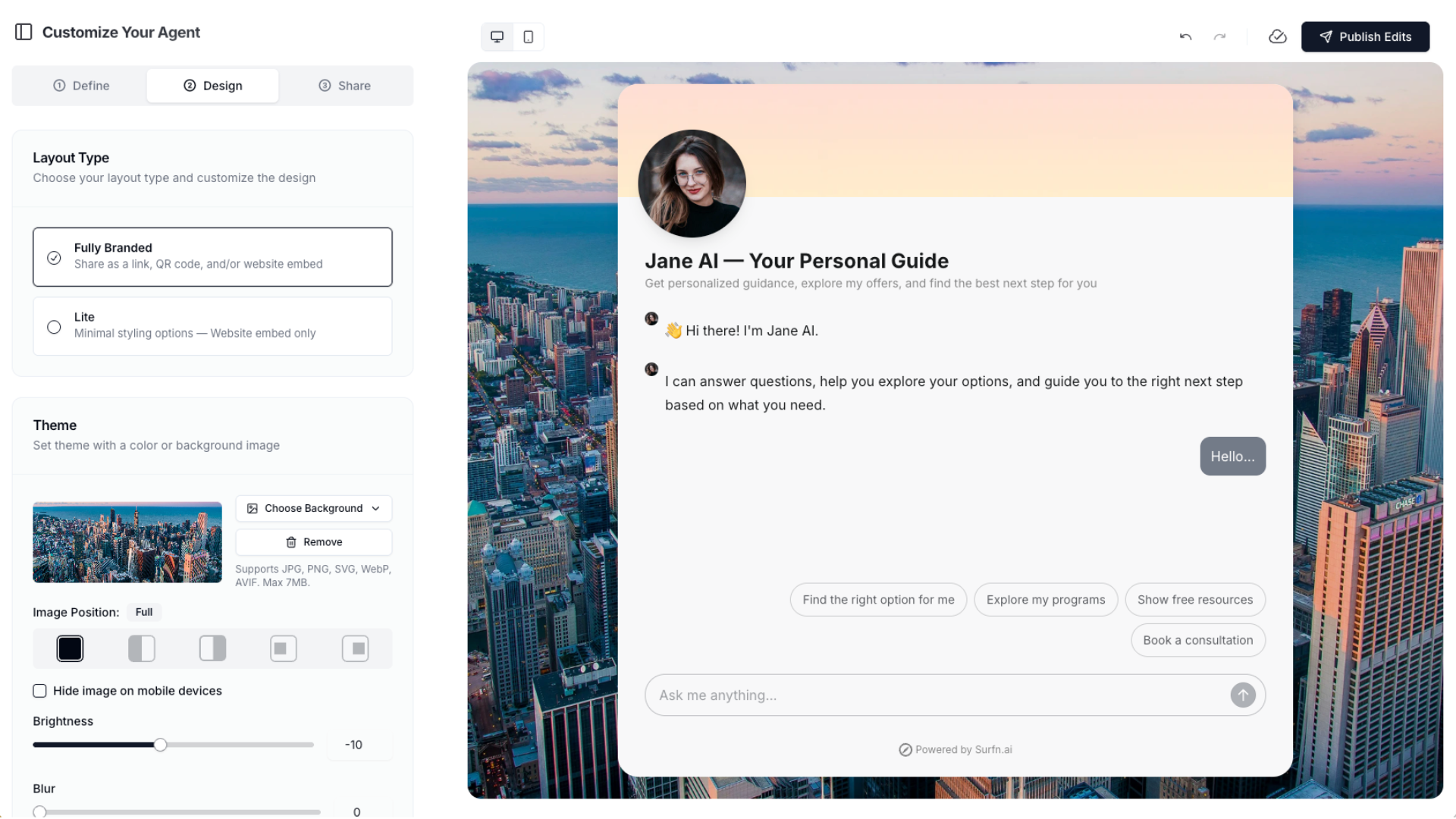
Your conversion agent should not feel like a generic chatbot bolted onto the site.
Customize the profile, colors, font, background, banner, and layout so the experience matches the business around it.
This matters even more for agencies building agents for clients.
Surfn also supports white-label branding and custom domains, so client-facing agents can feel like part of the client's own funnel.
Step 9: Test the flow before sending traffic
Test the agent like a prospect.
Try:
- a strong lead
- a poor-fit lead
- a pricing question
- a custom strategy request
- someone who changes topics
- someone who interrupts qualification
- someone ready to book immediately
Test on desktop and mobile.
Then publish.
Where to Deploy Your Agent
Do not deploy everywhere because you can.
Put the agent where people already have intent.
Website-wide popup
Good for businesses that already have website traffic and want pre-sale Q&A available across multiple pages.
Use welcome message bubbles that appear shortly after a visitor lands on the site to draw attention to the agent, rather than leaving it unnoticed in the corner.
High-intent pages
Put the agent directly where people hesitate:
- services
- pricing
- landing pages
- case studies
- FAQs
- booking pages
Surfn supports Inline, Modal, Slider, Popup, and Full Page website experiences.
Before the calendar
This is especially useful for agencies and consultants.
Instead of:
Book a Call → Calendly
try:
See If We're a Fit → Conversation → Qualification → Calendar
Now the prospect can get clarity before committing their time.
And your calendar gets better context before the meeting happens.
Link in bio
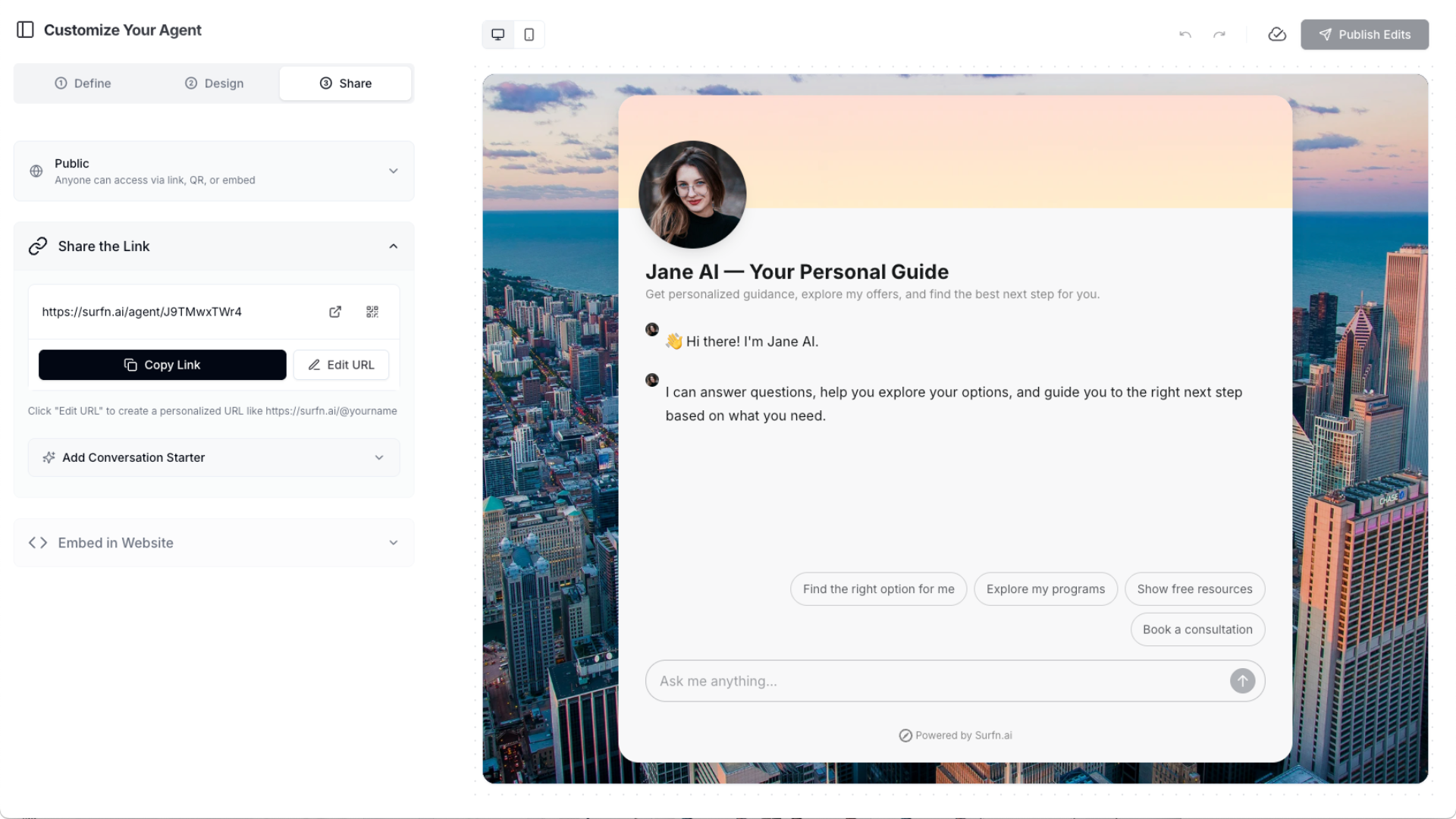
For coaches, consultants, founders, and creators, the AI Page can become the main link in bio or one option inside an existing link hub.
A social visitor can ask questions, understand the offer, and take the next step without navigating a full website.
For a deeper walkthrough, read How to Turn Your Link in Bio Into a 24/7 AI Sales Agent.
Email and DM follow-up
Give interested prospects another option besides replying or booking immediately.
In outbound, someone may open your email or DM, have some interest, and still not be ready to start a sales conversation. A conversational agent gives them a low-pressure way to learn more, ask questions, see relevant proof, and decide whether they want to move forward on their own time.
You can add a simple option such as:
Have questions before booking? Ask our AI.
Some people want to keep researching before speaking with you. Let them.
Lead magnets and content
Add the agent:
- inside a PDF
- after a webinar
- at the end of an article
- inside a newsletter
- alongside educational content
Do not let the experience end when the content ends.
Give people somewhere to ask the next question.
QR codes
Use a QR code at conferences, workshops, events, presentations, or on printed sales material.
Instead of sending someone to
a generic homepage, send them into a conversation built for that moment.
For more deployment ideas, see Introducing Conversational AI Pages.
For Agencies: Turn This Into a Client Service
Agencies can use the same playbook twice: for themselves and for their clients.
Use it on your own funnel first, then repeat the same model for clients. For a client:
- Train the agent on the client's website, offers, FAQs, and proof.
- Define the client's qualification criteria.
- Build the lead capture and action flows.
- Match the client's branding.
- Deploy it across the client's site or campaigns.
- Review the conversations and improve the flow.
Instead of selling a client “an AI chatbot,” sell them a better conversion path for traffic they already have. That is a much easier business outcome to understand.
The client already spent money getting someone to the website. Your job is to help more of those interested visitors get answers, become leads, establish fit, and move forward.
Start Where Good Prospects Drop Off
You do not need to make your entire funnel conversational. Find the point where good prospects are hesitating or disappearing.
Maybe it is before they fill out your form. Before they book a call. After they download your lead magnet. Or after they open your outbound email or DM but never reply.
Start there.
Build one focused conversational flow around that moment. Give prospects an easier way to get answers, share their information, establish fit, see relevant proof, and take the next step without having to navigate the rest of the funnel alone.
Then watch the conversations. See what people ask, where they stop, what proof they want, and which next steps move them forward. Use that information to improve the experience.
The goal is not more automation. It is fewer dead ends between interest and action.
Answer the question. Capture the lead. Qualify the fit. Show what matters. Guide the next step.
Build Your Top-of-Funnel AI Agent
Turn pre-sale questions, lead capture, qualification, proof, and next steps into one branded conversation with Surfn.