Claude’s role in marketing shouldn’t end when the content is published.
Most businesses use Anthropic's Claude behind the scenes to create posts, emails, landing pages, and lead magnets. But the bigger opportunity begins after that content earns someone’s attention.
An interested prospect may understand what you offer and still wonder which option fits, how it applies to their situation, or what to do next. Static content can’t answer those questions differently for each person. A Claude-powered conversational AI agent can.
This is where AI becomes more than a content-production tool. It becomes a personalized layer between interest and action.
The Problem Isn’t Always a Lack of Information
Businesses often respond to weak conversion by creating more content.
They add another FAQ, sales page, comparison chart, or guide. Each asset may be useful, but more information does not automatically create more clarity. It can leave the prospect with more to interpret.
The real gap is often not information. It is guidance.
Content explains what a business offers. Guidance helps a prospect understand what that information means for their specific goals, concerns, and circumstances.
That distinction matters when an offer requires consideration. Services, software, and educational programs cannot always be evaluated from a few headlines and feature lists. Prospects need help deciding what applies to them.
What a Good Salesperson Adds Beyond the Facts
Imagine you are shopping for a laptop at Best Buy.
The specifications, prices, and reviews are already available. You can compare memory, storage, processors, screen sizes, and battery life without speaking to anyone.
But you may still wonder:
Which model fits how I will actually use it?
Which differences will I notice?
Do I need the more expensive option?
A knowledgeable salesperson does not simply repeat the specifications. They ask whether you travel often, edit videos, run demanding software, or only need the laptop for everyday work. Then they explain the tradeoffs that matter for your situation.
The facts did not change. The context did.
That is personalized pre-sale education: helping someone evaluate an offer in the context of their needs. It reduces the work required to make sense of the options and gives the buyer more confidence in the decision.
Most online buying experiences still lack that layer.
Static Marketing Leaves Prospects to Finish the Decision Alone
Rupali Renjen is the co-founder of Surfn AI, where she builds conversational AI agents that help businesses and creators engage audiences, uncover deeper audience insights, and turn more conversations into growth.
A website, sales page, social post, newsletter, video, or lead magnet communicates in one direction. It can anticipate common questions, but it cannot respond to the exact question that appears after someone reads or watches it.
That creates a costly gap. The prospect is interested, but not ready to act. They plan to return later, but many do not. Others choose the competitor that makes the decision easier.
This does not mean the content failed. It may have completed its job, while the next layer was missing.
Gartner found that B2B buyers prefer digital self-service when looking for general information, but prefer seller input for tasks requiring context, such as determining whether an offer fits their company’s needs. Gartner’s recommendation was clear: sellers should provide unique guidance instead of repeating generic information buyers can find elsewhere.
Many prospects prefer to research independently. But self-service should not mean figure it out alone.
What Personalized AI Guidance Should Actually Do
A general-purpose AI chat box is not enough. Useful guidance requires trusted business knowledge, clear boundaries, and an intentional path forward.
A strong conversational pre-sale experience should do six things:
Stage
What the AI agent does
Why it matters
Understand the need
Asks what the prospect wants to accomplish
Establishes context before giving an answer
Identify the uncertainty
Clarifies the question or concern blocking progress
Focuses the conversation on the real decision
Answer from approved knowledge
Uses the business’s offers, FAQs, case studies, and guidelines
Keeps the guidance grounded and relevant
Surface relevant proof
Shares the right example, resource, testimonial, or explanation
Helps the prospect evaluate fit with less searching
Guide the next step
Recommends an appropriate action based on the conversation
Turns clarity into forward movement
Involve a human when needed
Routes complex, high-value, or sensitive decisions to a person
Preserves human judgment where it adds the most value
The business defines the knowledge, instructions, boundaries, and available actions. The AI uses that context to make the buying experience more responsive, not to make unrestricted decisions for the buyer.
AI Should Support Salespeople, Not Pretend to Replace Them
AI is valuable when it answers repetitive pre-sale questions, explains existing information, asks initial discovery questions, and surfaces relevant proof. It gives prospects a low-friction way to learn before committing to a meeting.
But a personalized AI conversation is not a substitute for human judgment.
Personalized Guidance Should Be Available Wherever Interest Begins
Interest does not begin in one predictable place. A prospect may first encounter a business through a website, social post, newsletter, lead magnet, or QR code.
Yet most businesses confine conversation to a website chat widget and send everyone from other channels to another static page. The prospect clicks, reads, and still has to determine what to do next alone.
A better approach is to make the conversational layer portable. It can be embedded on a high-intent webpage, shared as a Conversational AI Page, added to a link in bio, or opened through a QR code.
The goal is not to replace the funnel. It is to give prospects a responsive path wherever interest begins.
How Surfn Turns Static Touchpoints Into Guided Conversations
Surfn lets businesses create branded conversational AI agents for marketing funnels. An agent can be grounded in websites, files, FAQs, offers, and other approved sources, then configured with a defined role, instructions, and conversation journey.
The agent can answer pre-sale questions, ask what someone is trying to accomplish, surface relevant content, collect or qualify information, and guide an appropriate next step such as a resource, form, offer, or booking calendar.
The experience can live on a branded, shareable AI Page, open from a link or QR code, or be embedded into an existing website.
Although this article focuses on Claude, Surfn is not limited to one provider. Businesses can choose from leading AI models, including Claude from Anthropic, Gemini from Google, and models from OpenAI, then ground the selected model in their own content and instructions.
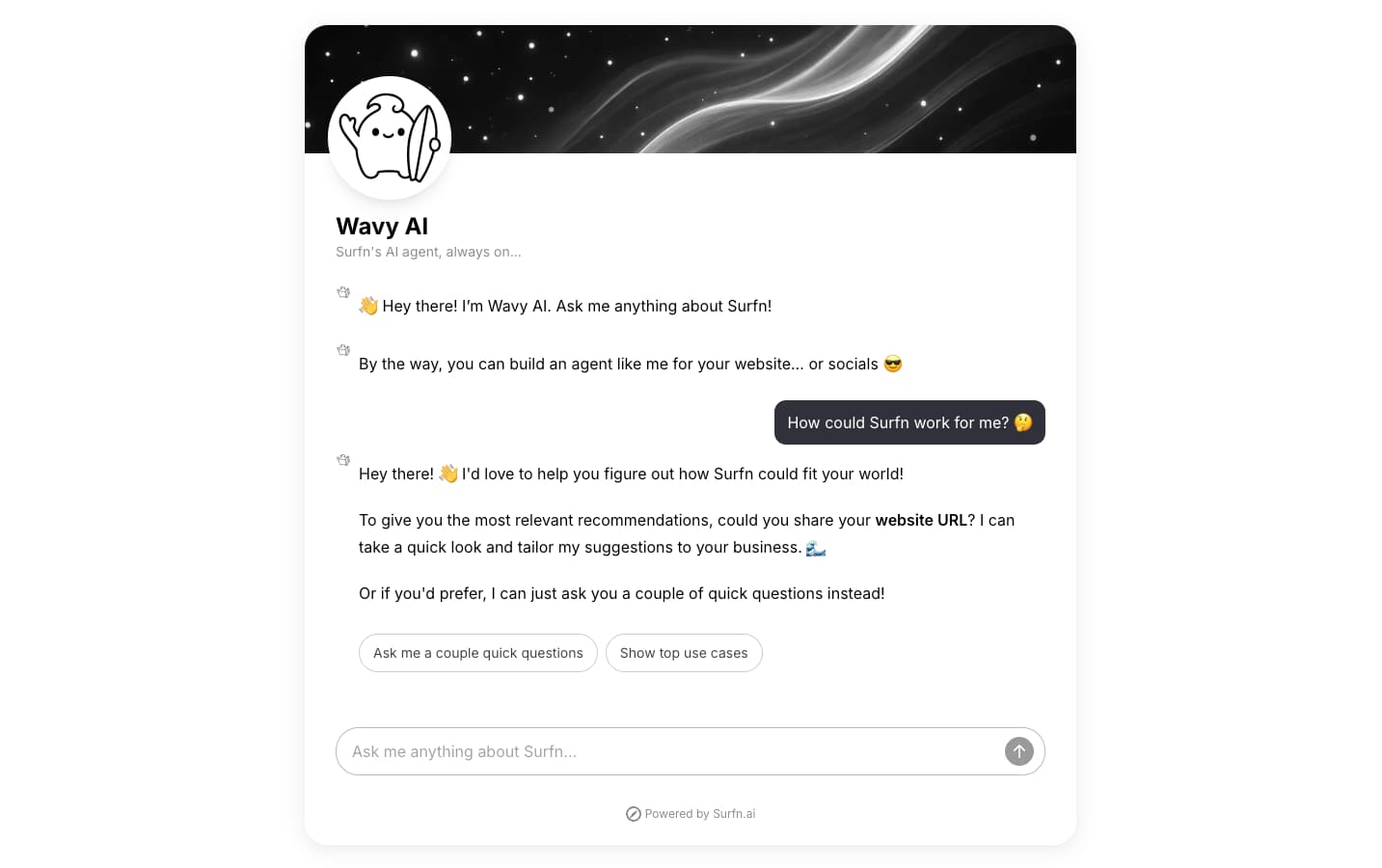
To see the idea in practice, enter your website into Wavy AI, Surfn's AI assistant. It will use that context to give you personalized guidance on how a conversational AI agent could fit into your marketing funnel.
Content Can Explain. Conversation Can Help Someone Decide.
Content still matters. It earns attention, communicates expertise, and gives prospects the information they need to begin evaluating an offer.
The mistake is expecting static content to complete every decision.
Claude and other leading AI models create a larger opportunity than producing more marketing assets. They can turn existing business knowledge into personalized conversations that clarify fit and guide the next step.
The goal is not more AI-generated marketing. It is a more useful buying experience.
Static content can explain what you offer. A personalized conversation can help someone understand why it matters to them.
Frequently Asked Questions
How can Claude be used in marketing beyond content creation?
Claude can power conversational experiences that answer questions, interpret a business’s approved information in context, surface relevant resources, and guide prospects toward an appropriate next step.
What is personalized pre-sale education?
Personalized pre-sale education helps a prospect understand an offer, compare options, evaluate fit, and decide what to do based on their specific needs rather than receiving the same generic information as everyone else.
Can a conversational AI agent replace a salesperson?
No. It can handle guidance based on existing approved knowledge and prepare prospects for the next step. People remain important for complex judgment, reassurance, negotiation, and higher-risk decisions.
Does Surfn only support Claude?
No. Surfn lets businesses choose from multiple leading AI models, including Claude from Anthropic, Gemini from Google, and models from OpenAI.
Where in your buying journey are prospects still being left to figure out the decision alone?